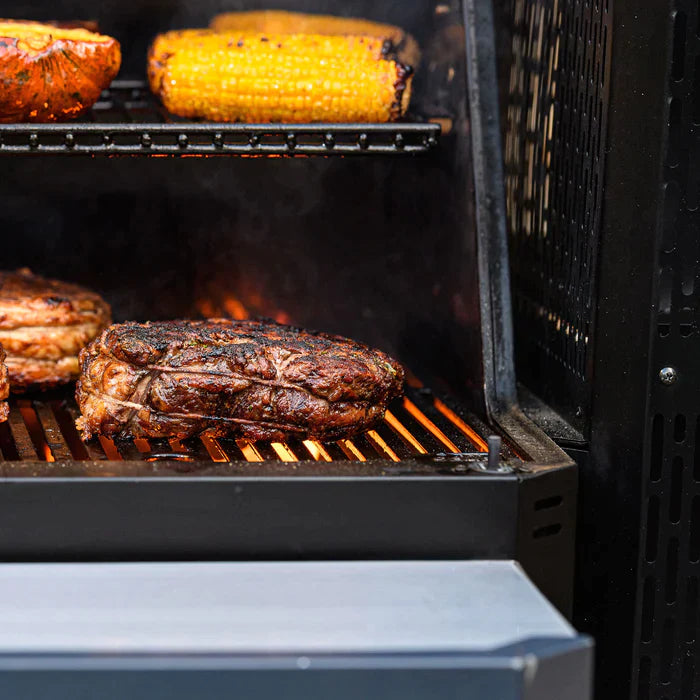
A fan, a hopper, and a fire that never needs a fire-tending session

Gravity-fed charcoal grills solve one problem: the thing that makes charcoal taste better than gas is also the thing that makes it a pain to use — you have to babysit it. Masterbuilt's Gravity Series answers that by feeding the fire mechanically instead of by hand. Load the hopper, light the base, set a temperature on the digital panel, and a variable-speed fan does the vent-tweaking a live-fire cook usually demands.
If you want the model-by-model breakdown of the 1150 specifically — build quality, the app, how it compares to the 1050 it replaced — we've already written that review. This one's about the mechanism itself: how gravity-feed actually works, where it sits between a kamado and an electric smoker, and what it quietly gives up to get there.
How the hopper actually does the work
Charcoal sits in a sealed vertical hopper beside the main cooking chamber. Lit charcoal at the bottom burns down, ash falls into a catch bin, and gravity pulls the charcoal above it down to replace what's gone — hence the name. A fan mounted at the base of the hopper feeds that fire exactly as much oxygen as it needs to hold the temperature you set on the digital controller, easing off to a near-silent crawl once you're at target and stoking hard again the moment the chamber cools.
It's the same control loop a pellet grill uses — a thermostat driving a fuel-feed mechanism — borrowed and applied to real lump charcoal or briquettes instead of compressed pellets. That's the entire pitch: pellet-grill convenience, charcoal-grill flavour.
The three sizes we stock, and what the number in the name means

Masterbuilt names each model roughly after its cooking area in square inches, so the model number does most of the size-comparison work for you before you've read a single spec sheet.
- Gravity Series 600 — the smallest active model in the range, and the one to start with if you're feeding a household rather than a crowd.
- Gravity Series 800 — meaningfully more cooking area, and the point where reverse-searing a full batch of steaks after a long smoke stops feeling cramped.
- Gravity Series 1150 — 1,150 square inches across three levels, built for the cook who's regularly feeding a genuine crowd, not just a family.
What it's genuinely better at, and what it isn't
Low and slow is where gravity-feed earns its keep. A full hopper holds a stable temperature for hours without a single vent adjustment, which is exactly the part of charcoal cooking that used to demand the most attention. Brisket, pork shoulder, ribs — the cooks where consistency over many hours matters more than raw heat — are the strongest case for buying one.
Direct-flame searing is the weaker side. The heat source sits at the bottom of the hopper, some distance from the actual cooking grates, so you get strong ambient heat but not the flame-licked char of a live-fire kettle or kamado with the coals right under the grate. It gets hot enough to sear — the 1150 runs up to 700°F — but if a hard crust from direct flame contact is the whole point of your steak night, a kamado or a straightforward charcoal kettle still does that specific job better.
How it sits next to a kamado and an electric smoker
A Kamado Joe holds heat through thick ceramic walls and needs almost no fuel to run for a long cook, but every temperature change is a manual vent adjustment — you're the thermostat. A Bradley electric smoker removes fire management entirely by using an element instead of combustion, at the cost of the deeper charcoal character. Gravity-fed charcoal sits between the two: real charcoal and wood-chunk smoke, but a machine doing the vent-tweaking instead of you.
The trade you're making either way is the same shape: hand over some of the hands-on ritual, keep the flavour that ritual was chasing. Whether that's a good trade depends on whether you enjoy tending a fire or just want the result it produces.
One practical thing worth planning for
The fan and controller need mains power to run. That's a minor detail until the day a cord isn't handy or the power drops mid-cook — the fan stops, and without it the fire can't hold its set temperature the way it did a moment before. Plan your outdoor power point before the grill arrives, not after.
Frequently asked questions
Do I load charcoal or briquettes into the hopper?
Either. Lump charcoal and briquettes both work — briquettes tend to burn more predictably over long cooks, lump charcoal burns a little hotter and lights faster.
How long does a full hopper last?
Depends on the model and the temperature you're running, but a full hopper on the larger models can comfortably carry a long overnight smoke without a refill. Hotter, hands-on grilling burns through fuel noticeably faster than low-and-slow.
Can I sear a steak on it?
Yes — the bigger models run up to 700°F — but the heat comes from below the grates rather than direct flame contact, so the crust is closer to a very hot oven than a live-fire char. Good, not identical to a kamado sear.
What happens if the power cuts out mid-cook?
The fan stops feeding the fire, so it can't hold its set temperature the way it was a moment before. It's the one real vulnerability of the design — a fully manual charcoal grill doesn't have this failure mode.
Is this the same as a pellet grill?
No — the control logic (a thermostat driving a fan) is borrowed from pellet grills, but the fuel is real lump charcoal or briquettes, not compressed wood pellets. That's the entire reason people choose gravity-fed over pellet: charcoal flavour with pellet-grill convenience.
Which size should I buy?
The 600 suits a household cooking for itself most weeks. Step up to the 800 if steak nights for a full table matter to you, and to the 1150 only if you're genuinely feeding a crowd on a regular basis.