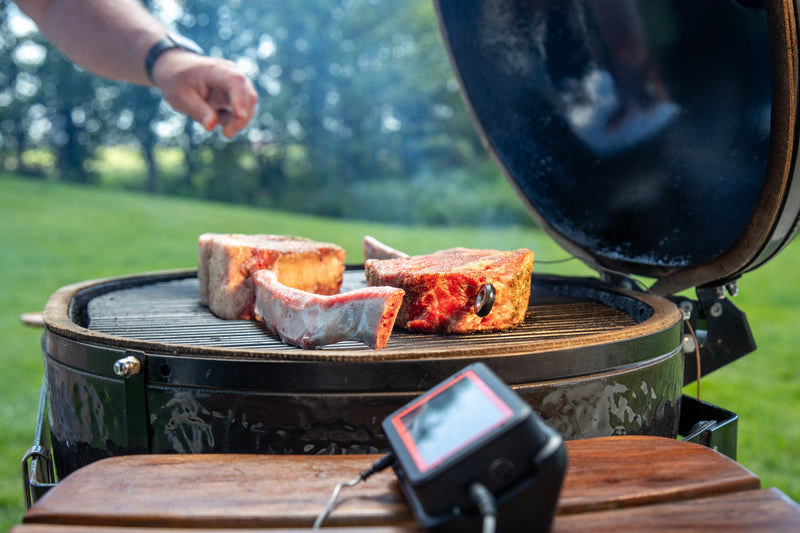
A kamado or a kettle reaches 240C with room to spare, so the part of pork crackling that needs planning happens on Christmas Eve, in the fridge. Score the rind 1 cm apart, pat it dry and leave the roast uncovered overnight, then rub in 2 tablespoons of oil and 1 tablespoon of sea salt just before it goes on. After that the cooker runs an ordinary two-temperature roast, and a 2 kg rolled loin comes off when the centre reads 75C.
On a kamado that loin takes 60 to 70 minutes at 180C, which is Australian Pork's 30 to 35 minutes a kilo. Then open both vents, allow 10 to 15 minutes for the dome to climb, and give the rind about 10 minutes at 240C, until it has bubbled all over. For a 1 pm lunch, light the charcoal at 10.20.
What makes pork rind crackle
Australian Pork, the industry body, puts the cause in one line: "Moisture prevents the pork rind from crackling." Its method gives the rind four things.
- Score lines. Cut them 1 cm apart and about 3 mm deep, stopping short of the meat. A rolled loin is sold already scored.
- A dry surface. Pat the rind dry with paper towel and put the roast in the fridge, rind up and uncovered, overnight. A few hours is the minimum.
- Oil and salt. Rub 2 tablespoons of oil and 1 tablespoon of sea salt into the scores of a 1.8 to 2 kg loin just before it goes on.
- A stretch at 240C with the lid shut. Australian Pork roasts a loin at 240C, and Weber Australia's high setting for a kettle is 230 to 260C, so 240C suits a kamado, a kettle and a kitchen oven alike. Australian Pork's lowest figure for crisping rind is 220C.
Where that hot stretch falls depends on the cooker. The steps are further down: the Christmas Eve prep, the kamado setup, the kettle setup and a timing table for a 2 kg rolled loin on each cooker.
Cooking the pork outside also leaves the kitchen oven free for the vegetables and the ham.
Use the minutes for planning and judge the rind by eye. It is finished when small bubbles have formed across the whole surface and it is golden and crisp. A patch that is still smooth and flat gets a few more minutes with the lid down.
The best cut for pork crackling: loin or belly, and how much to buy
Ask around and most people will name belly as the crackling cut, and it is a good one. A belly is a flat slab with a thick band of fat under the skin, and all of its rind sits on top, facing the heat. It follows the same method as the loin with one change to the clock: 35 minutes a kilo at 180C, where a rolled loin gets 30 to 35. A 1.5 kg belly needs about 53 minutes at 180C before the hot finish. If belly is what your table expects, buy belly.
The times on this page are worked out for a 2 kg rolled loin, chosen with Christmas lunch in mind. A rolled loin is the same thickness from end to end, so it cooks evenly and carves into round slices of one size, each with a strip of crackling on the edge. The meat is lean and tender, and lean meat dries out if it stays on past done, so cook this roast to a probe. You can have both cuts in one roast if you ask the butcher for a skin-on loin with the belly left attached and rolled around it. Shoulder and leg crackle as well, at 35 minutes a kilo. A boned shoulder is the more forgiving of the two because it carries more fat. A leg is very lean, so for a crowd buy it on the bone, which helps keep it moist.
For quantity, allow 250 g of raw boneless pork a head, or about 350 g when the roast is on the bone. Past eight people, two rolled loins are easier to handle than one long one, and two side by side take about as long as one because each cooks as its own 2 kg roast. The time column below is the 180C stage, which on a kamado comes before the 240C finish. The last column is the centre temperature the roast comes off at: 75C for anything boned, rolled or stuffed, a rolled belly included, and 70 to 75C for a cut left whole. Where to put the probe and how long to rest the roast are under pork internal temperature.
| Roast | Typical weight | Feeds | Time at 180C | Centre temperature |
|---|---|---|---|---|
| Rolled loin, boneless | 1.5 to 2 kg | 6 to 8 | 30 to 35 minutes a kilo, so 45 to 70 minutes | 75C |
| Belly slab, boneless | 1.5 to 2 kg | 6 to 8 | 35 minutes a kilo, so 53 to 70 minutes | 70 to 75C |
| Shoulder or leg, boned and netted | 1.5 to 2 kg | 6 to 8 | 35 minutes a kilo, so 53 to 70 minutes | 75C |
| Rack on the bone, 8 ribs | About 2.5 kg | 8 | 60 to 70 minutes | 70 to 75C |
| Small rack on the bone | 1 to 1.5 kg | 4 | No published time, so go by the probe | 70 to 75C |
| Leg or shoulder on the bone | 3.5 to 4 kg | 10 to 12 | 35 minutes a kilo, so about 2 hours to 2 hours 20 | 70 to 75C |
The weights, serves and times in the table are Australian Pork's, the small rack is Weber Australia's and the centre temperatures are the Food Safety Information Council's. Use the minutes to plan the day and take the roast off on the probe reading.
Order the roast now and book the pick-up for 23 December. Cut-off dates vary from butcher to butcher: one Melbourne butcher closed its Christmas pick-up orders on 22 December in 2025 and its delivery orders on the 18th, so ask for the date when you order. When the roast gets home, take it out of its wrapping, wipe the rind dry with paper towel and put it in the fridge uncovered with the rind up. Collected on the 23rd, it has two nights there before Christmas lunch. Rind comes out of a vacuum pack pale and damp, and the recommended drying time for rind in that state is 24 to 48 hours, so two nights covers it. A roast that was dry at the counter loses nothing by the extra night. At the counter:
- Look at the rind. Choose a roast whose rind looks and feels dry. Rind that has been vacuum-sealed in plastic is much harder to crackle, so pick pork wrapped in paper where there is a choice. Some butchers seal everything they sell online, and the two nights in the fridge are there for that roast.
- Check the fat. You want an even layer under the rind for the whole length of the roast. Ask the butcher to leave it untrimmed.
- On a rolled roast, ask that no rind is rolled up inside. Rind wrapped into the middle comes out rubbery.
- Ask for it scored. Rolled loins are usually sold that way, and a butcher will score any other cut for you.
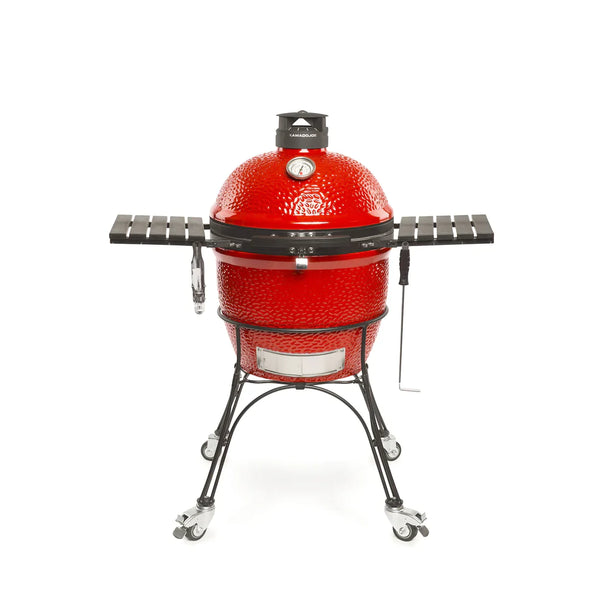
- Take two measurements with you. The kamado in this guide is a Kamado Joe Classic Joe II, and its grate is about 46 cm across. The roast, or two side by side, has to sit inside that circle with the dome shut. On a 57 cm kettle the pork sits over a drip tray between the two charcoal baskets. Weber's large drip tray is about 23 cm by 33 cm, so keep a kettle roast to 33 cm or shorter. Butchers will cut a roast down to the length you ask for.
The day before: score and dry the rind, then salt it on the day
For Christmas lunch this is a Christmas Eve job, done when the pork comes home from the butcher. The prep is the same whichever cooker the roast ends up on, and the quantities suit a 1.8 to 2 kg rolled loin.
Christmas Eve
- Unwrap the pork. Leave the netting on a rolled loin and press paper towel over the rind until a fresh sheet comes away dry.
- Check the scoring. You want even lines 1 cm apart and about 3 mm deep, through the rind and stopping short of the meat. A rolled loin is sold already scored, so this is usually a touch-up with a small sharp knife: deepen any shallow line and add one wherever the gap is wider than 1 cm. If the cut comes unscored, ask the butcher to do it. If every knife in the drawer is too big or too blunt for the job, the Tramontina Nômade boning knife has a 15 cm blade, and you will pick it up again on the day if the rind has to come off in one piece.
- Sit the roast rind up on a rack inside a tray and put it in the fridge uncovered. Give it the lowest shelf, so the tray catches any drips and the food that will be eaten without cooking sits above the raw pork. The fridge should be running at 5C or colder.
| Time uncovered in the fridge | When it applies |
|---|---|
| 1 hour to a few hours | The pork was bought on the day. Australian Pork gives 1 hour as the minimum. |
| Overnight | The standard. In on Christmas Eve, out when the cooker is nearly up to temperature. |
| 24 to 48 hours | The skin looks pale and still feels damp after patting. This is Weber Australia's figure, and for Christmas lunch it means starting on 23 December. |
Christmas morning, while the cooker heats
- Take the pork out of the fridge and pat the rind once more with paper towel, working into the score lines.
- Rub in 2 tablespoons of vegetable oil, then 1 tablespoon of sea salt, pushing both down into every score with your fingers. A smaller piece of rind takes 1 tablespoon of oil and half a tablespoon of salt. The pork then goes straight onto the cooker.
Oil and salt wait until step 5, so the rind spends the night bare. Australian Pork's method adds one optional extra before the oil: stand the roast on a rack in the sink and pour a jug of boiling water over the rind. If you do it, pat the rind thoroughly dry again, pressing the towel along each band of netting, before the oil and salt go on.
Setting up a kamado for roast pork with crackling
These steps are written for a Kamado Joe Classic Joe and the 2 kg rolled loin. The pork roasts over indirect heat, which on a Classic Joe means two ceramic half-moon deflector plates between the charcoal and the cooking grate, with the loin above them and the rind facing up. A Classic Joe Series II comes with both plates in the box, and they stay in for the whole cook, the hot finish included. Allow 50 minutes from lighting the charcoal to putting the pork on.
Choose where the cooker will stand on Christmas Eve, while it is cold and easy to wheel about. Kamado Joe asks for a level surface that will not burn, 3 m clear of walls, rails and anything combustible, with nothing overhead. Its manual rules out roofs, carports and awnings, so a roofed pergola or alfresco is out as well. If that is where yours lives, move it onto open paving or concrete the night before.
- Fill the firebox with lump charcoal, up to the Classic II maximum of 2.7 kg. The fire will be alight for close to two and a half hours by the time the pork comes off, so fill it properly. A 9 kg bag of Kamado Big Block XL is three full loads, enough for a practice roast in early December, Christmas Day and one spare.
- Push one or two fire starters into the charcoal and light them. Kamado Joe says never to use lighter fluid.
- Slide the bottom vent fully open and leave the dome up for 10 minutes while the fire takes.
- Set the two deflector plates on their rack, then the cooking grate above them. A drip pan on the plates will catch the fat. Leave it dry, because liquid should never be spilled inside a hot kamado and the rind has just spent a night drying. Leave the grate bare as well, with no foil over it.
- Close the dome with both vents about half open.
- As the gauge nears 180C, start closing the top and bottom vents a little at a time. A change takes 10 to 15 minutes to show on the gauge, so make one and wait before making another. Creep up on 180C from below. Thick ceramic is slow to give heat back, and Kamado Joe's own advice is that raising the temperature slightly is much easier than bringing it down after an overshoot.
- Hold 180C for 20 to 40 minutes before the pork goes near it, so the gauge stays steady once the dome has been opened and shut. By the end of it the charcoal should have a coat of grey ash, which Kamado Joe wants to see before any food goes on.
- Put the oiled and salted loin in the middle of the grate with the rind up, and shut the dome.
From here the cook is two vent positions, set out step by step in the timing section. Any time you lift the dome above 175C, raise it 5 to 8 cm and hold it for about 5 seconds before opening it fully, which lets the heat out gently and prevents a flashback.
An older Classic Joe sets up the same way as long as both deflector plates are in one piece. If one has cracked, the half-moon deflector plates are sold as a pair and fit the Classic Joe I, II and III. The vents work the same on every model, whatever the top cap looks like: open them for more heat and close them for less.

Cooker temperature and timing for roast pork with crackling
Roast pork with crackling needs two cooker temperatures: about 180C to cook the meat and 220 to 240C to blister the rind. Which one comes first depends on what you are cooking in. Here is the full sequence for a 2 kg rolled loin in each cooker, lid or door shut throughout.
| Cooker | First stage | Second stage | Allow, pork on to pork off |
|---|---|---|---|
| Kamado | 180C for 60 to 70 minutes | Open both vents, 10 to 15 minutes to climb, then 240C until the rind has bubbled all over. First look after 10 minutes. | 80 to 95 minutes |
| 57 cm kettle | 230-260C for 20 to 30 minutes | 190-230C until the probe alarm sounds | 1 hour 50 |
| Hooded gas BBQ, indirect | 230-260C for 20 to 30 minutes | 190-230C until the probe alarm sounds | 1 hour 50 |
| Kitchen oven | 240C (220C fan-forced) for 40 minutes | 180C (160C fan-forced) for 60 to 70 minutes | 1 hour 40 to 1 hour 50 |

A kamado runs the stages the other way round from an oven. Kamado Joe's manual warns that it is much easier to nudge the heat up than to bring it down after an overshoot, so the lower temperature goes first. The manual puts roasting at 150 to 230C and grilling at 205 to 315C, so 240C is well inside what the cooker reaches on open vents.
- Pork on at 180C, over the deflector plates, dome shut. Leave it for 30 to 35 minutes a kilo: 45 to 53 minutes for a 1.5 kg loin, 60 to 70 for 2 kg, 75 to 88 for 2.5 kg.
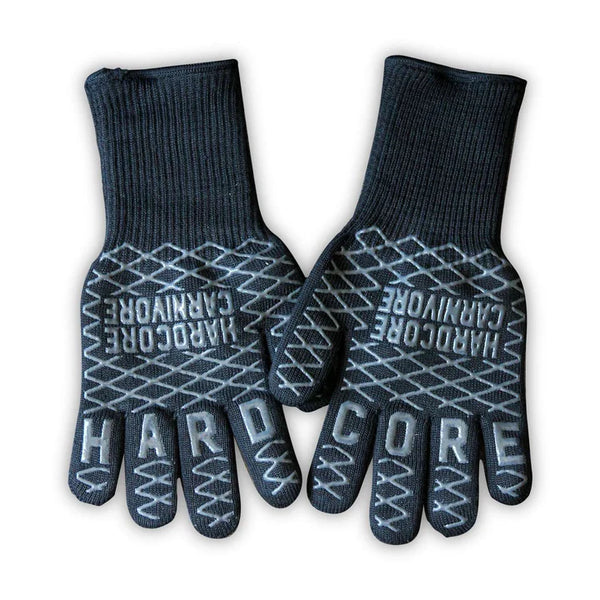
- Kamado Joe's manual says to wear protective gloves when you adjust the vents, so put on the Hardcore Carnivore gloves and open the top and bottom vents fully. A vent change takes 10 to 15 minutes to show on the gauge, so leave the dome shut while it climbs.
- When the gauge passes 220C, start a 10-minute timer and let the dome carry on to 240C.
- At 10 minutes, burp the dome (lift it 5 to 8 cm and hold for about 5 seconds), then open it and look. A finished rind is covered in small bubbles from end to end, golden and crisp.
- If any of it is still flat and smooth, shut the dome and give it another 10 minutes before the next look, and repeat until it has bubbled. Australian Pork allows 40 minutes at 240C for a rind that starts cold, so treat that as the outside limit, and wind the top vent back a little if the gauge heads past 240C.
The 80 to 95 minutes in the table assumes the rind is done at the first look. If the probe alarm sounds while the rind is still flat, take the pork off and finish the rind on its own, as set out under if the meat is done before the rind.
On a kettle or a hooded gas barbecue the hot stage comes first, and these are Weber Australia's settings for both. Put the pork in the indirect zone at 230-260C and leave the lid down for 20 to 30 minutes without lifting it. Then bring the heat down to 190-230C: on a kettle, close the lid vent partway and leave the bottom vent open; on gas, turn the lit burners down. Weber lists 90 minutes for a 2 kg rolled loin cooked to medium. This page cooks a rolled loin further than that, for the reason given under internal temperature, so allow 1 hour 50 and let the probe alarm end the cook. If a kettle starts to sag before then, open the lid vent again and check the bottom vent is clear of ash. The hinged sides of the cooking grill let you drop in more briquettes.
The kitchen oven follows Australian Pork's method: 240C for 40 minutes with the door kept shut, then down to 180C for the same 30 to 35 minutes a kilo. A leg or shoulder gets up to 50 minutes at 240C and then 35 minutes a kilo at 180C, which is 3 hours 10 for a 4 kg roast. All of these times are for planning the day. The probe alarm decides when the pork comes off, on every cooker.
Pork internal temperature, resting and carving
The Food Safety Information Council gives two figures for roast pork. A whole roast, such as a belly slab or a bone-in rack, is done at 70 to 75C in the centre. Anything rolled, boned or stuffed needs 75C, and that covers the rolled loin this method is written around. Australian Pork's loin recipe stops at 65C; we use the food-safety figure. The council also asks for 3 to 5 minutes of rest, which the carving rest below takes care of.
Put the probe in the thickest part of the roast, as close to the centre as you can get it, clear of bone, fat and gristle. The council's advice is to always use a meat thermometer, and a digital food thermometer with an 11.8 cm probe is the simple way to do it. Weber's example loin is 90 mm thick, which puts the centre about 45 mm in from the side. Start checking a little before you expect the pork to be done, and shut the lid or the oven door between readings.
If you would sooner not open the lid at all, the FireBoard Pulse stays in the roast from start to finish. On a rolled loin, push it in through one end until at least 70 mm is buried, which is FireBoard's minimum, and set the app to alert you at 75C. A second sensor at the outer end reads the heat beside the roast up to 350C, so you can also see when the cooker has reached 240C. Our comparison of the Pulse and The MeatStick covers how each one copes inside a kamado.

Lift the pork onto a board and rest it for 10 to 15 minutes. Australian Pork covers the roast loosely with foil. Keep it loose, or leave the rind bare, so the steam coming off the meat can get away from the crackling. To carve, follow the score lines down through the rind and each slice takes its own strip of crackling with it. With a very crisp rind it is easier to lift the crackling off in one piece, slice the loin thin and break the rind over the top.
Reheat leftover pork to 75C before it goes back on a plate.
If the crackling has not crackled: fix it while the pork rests
Rind that is still flat or chewy when the pork comes off can be finished while the meat rests, and the rest takes 10 to 15 minutes anyway. Run the boning knife under the rind and lift it away in one piece. Cover the meat loosely with foil and put the rind back in the heat by itself, skin side up. The times below are for the rind alone, so the cut it came off makes no change to them. Weber Australia wrote its version for a rack of pork and Australian Pork for a rolled loin, and the rind from a leg, belly or shoulder goes back the same way.
| Cooker | Where the rind goes | Heat | Time | Published by |
|---|---|---|---|---|
| Kamado | On the grate over the deflector plates, dome shut | 240C, both vents open | 10 minutes, then look | Good Food, written for an oven at 240C |
| Kettle | Middle of the grill, over the drip tray, lid on | 190-230C, lid vent fully open | 15 minutes, with one look at 10 | Weber Australia |
| Gas BBQ with a hood | On the indirect side, away from the lit burners, hood down | 190-230C | 15 minutes, with one look at 10 | Weber Australia |
| Kitchen oven | On a rack | 240C | 10 minutes | Good Food |
| Kitchen grill | Under the preheated grill | 200C | 4 to 5 minutes, watched, then 4 to 5 minutes standing | Australian Pork |
A kamado that finished the roast with both vents open is already at 240C, so the rind can go straight back on. Above 175C, burp the dome before each look by lifting it 5 to 8 cm for about 5 seconds. At 10 minutes you want small bubbles spreading across the surface. If they have started and not yet reached the far end, shut the dome and use what is left of the rest.
Weber gives one band for its fix, 190-230C, and nothing narrower. Its own crackle stage runs hotter, at 230-260C, so on a kettle open the lid vent fully when the rind goes back and let the fire climb toward the top of the band. On gas, turn the lit burners up to do the same. If a probe at grill level reads under 190C because the briquettes have burned down, use the kitchen grill. Stay beside it for the whole 4 to 5 minutes, since Australian Pork's instruction is to watch that the rind does not burn. Whichever heat you use, stop when the rest is up. Smooth rind comes off at that point and the blistered pieces go to the table. If one end crisped early, cut it away at the first look and send only the flat piece back.
For the next roast, the published methods point to a short list of causes.
- Damp rind. Australian Pork's answer is a night uncovered in the fridge, or a few hours at the least, and the steps for scoring, drying and salting the rind set out the order.
- Salt left on the surface. For a 1.8 to 2 kg loin, Australian Pork works 2 tablespoons of oil and 1 tablespoon of sea salt down into the scores just before cooking.
- The lid came up. Australian Pork's hot stage is 40 minutes without opening the oven door, and Weber's is 20 to 30 minutes without lifting the lid. The stage for your cooker is in the table of cooker temperatures and times.
- The cooker ran under 220C. Australian Pork roasts rind at 220 to 240C, calls getting the temperature right critical, and recommends checking it with an oven thermometer. On a barbecue the equivalent is a probe at grate level beside the roast, with the hot stage timed from the moment it reads 220C. Both thermometers are under internal temperature.
Roast pork with crackling on a 57 cm kettle BBQ
Weber Australia publishes its own method for roast pork with crackling on one. Nothing changes in the prep or the target. The rind is scored and dried overnight, oiled and salted just before it goes on, and a rolled loin still comes off at 75C in the centre. The settings below are Weber's for a 57 cm kettle burning briquettes.
- Open the top and bottom vents and take the lid off.
- Put two firelighters on each side of the charcoal grate and light them. Fill each of the two charcoal baskets with 22 to 24 briquettes, which is Weber's count for indirect high heat, and sit a basket over each pair of firelighters.
- Leave the lid off for 25 to 30 minutes, until the briquettes are at least 80 per cent ashed over.
- Slide the baskets out to opposite edges of the charcoal grate and put a drip tray between them. That means reaching in beside 44 to 48 lit briquettes, so wear a pair of Hardcore Carnivore High Heat BBQ Gloves, which have a silicone grip.
- Fit the cooking grill with its handles over the baskets, so the hinged sides can be lifted to add fuel. Put the lid on and wait 5 minutes.
- Put the pork in the middle of the grill, rind up, over the tray.
Turn the lid so its vent sits above the gap between the baskets. Weber's guide says a vent parked over one basket makes that side burn hotter and burn out sooner. It also notes that the lid thermometer reads wrong when it sits directly over the briquettes, and recommends a digital probe at grill level. The wireless probe under internal temperature gives that reading from beside the roast.
Weber cooks the hot stage first. Roast for 20 to 30 minutes at 230-260C without lifting the lid, then bring the kettle down to 190-230C for the rest of the cook. The temperature is set at the lid vent, with the bottom vent left open and clear of ash. For timing, Weber allows about 1 minute for every millimetre of thickness, so a roast 90 mm through takes 90 minutes to reach medium. You are cooking to 75C, so allow longer than that. The clock for a 2 kg loin is in the timing table above, which also explains why we run the two stages the other way round on a kamado and finish hot.
Other lidded charcoal barbecues follow the same layout, with the fuel at the sides, the pork in the middle and the lid on, though the briquette count above is Weber's for the 57 cm kettle only. For the ceramic route, the cooker we back is the Kamado Joe Classic Joe II, because it ships with the two heat deflectors and the top vent this roast uses, and our Joe Jr, Classic Joe and Big Joe comparison covers which size fits your household. Gravity-fed charcoal is a different setup again, and we have explained it in how gravity-fed charcoal works.
Christmas Day run sheet for a 1 pm lunch, and the backup for a total fire ban
The run sheet is for a 2 kg rolled loin carved at 1.00, with every stage given its longest published time. On the kamado, light at 10.20 and put the pork on at 11.10, even if the gauge has been sitting on 180C for a while. Kamado Joe allows anywhere from 20 minutes to an hour for the ceramic to settle, so the cooker can wait for the clock. From 11.10 the roast stage takes 60 to 70 minutes, the climb to 240C takes 10 to 15 and the rind gets about 10. The pork is off between 12.30 and 12.45 and carved, after a 15-minute rest, between 12.45 and 1.00. The table shows the later time at each step.
| Step | Kamado | 57 cm kettle | Kitchen oven (fire ban) |
|---|---|---|---|
| Christmas Eve | Rind scored, roast uncovered in the fridge. Check your state fire service for a ban. | ||
| Light or preheat | 10.20 | 10.20 | 240C by 10.55 |
| Pork on | 11.10 at 180C | 10.55 at 230-260C | 10.55 at 240C |
| Change the heat | 12.20, vents open for 240C | 11.25, lid vent partly closed | 11.35, down to 180C |
| Pork off at 75C | 12.45 | 12.45 | 12.45 |
| Carve | 1.00 | 1.00 | 1.00 |
The kettle and oven columns allow 1 hour 50 from pork on to pork off. Set the probe alarm for 75C and take the loin off when it sounds, which on a kettle may be well before 12.45. It can rest under loose foil while the vegetables catch up. If the rind is behind the meat at that point, it gets finished by itself during the rest, as set out in the section on crackling that has not crackled.
For a bigger roast, work out its time from the timing section, count that back from 12.45, and light the kamado 50 minutes before the pork goes on. A 2.5 kg rolled loin needs up to 1 hour 55, so it goes on at 10.50 and the charcoal is lit at 10.00. A 4 kg leg needs up to 2 hours 45, which means pork on at 10.00 and a 9.10 light. On the kettle the same leg gets 3 hours 10, so it goes on at 9.35 and the briquettes are lit at 9.00.
Check for a fire ban on Christmas Eve afternoon, about when the pork goes into the fridge. NSW normally makes the call the afternoon before, to start at midnight. WA announces a ban either the afternoon before or on the day, so look again on Christmas morning there. Queensland declares local fire bans by council area in place of total fire bans, and they can run from a few days to more than a week. Each state fire service publishes its own rules for barbecues on a ban day, and this is what they say for a backyard.
| State | Charcoal on a ban day | Gas barbecue on a ban day |
|---|---|---|
| Victoria (CFA) | Solid and liquid fuel barbecues and ovens are banned. | Allowed in a stable position with 3 metres clear of flammable material, a hose or at least 10 litres of water on hand, and an adult with it. |
| NSW (Rural Fire Service) | No barbecue burning wood, charcoal or heat beads outdoors. | Allowed within 20 metres of the house with nothing combustible inside 2 metres, a continuous water supply and a responsible adult present. |
| South Australia (CFS) | Wood and charcoal barbecues need a council permit, which is generally issued only for emergencies. | Allowed within 15 metres of the house and 4 metres clear of flammable vegetation, with an extinguisher at hand and someone able to control it present until it is out. |
| Western Australia (DFES) | No solid fuel barbecue, smoker or cooker anywhere that is not fully enclosed. Patios and pergolas count as open. | Allowed at home if the flame is enclosed and flammable material is cleared for 5 metres around it. |
| Tasmania (TFS) | Anything burning wood, charcoal or heat beads is banned. | LPG or electric is allowed with 1 metre cleared all the way around and above, and someone supervising. |
| Queensland (QFD) | Lighting a fire for any purpose is banned while a local fire ban is in force. | The Commissioner can allow some types of barbecue during a ban, so read the notice for your council area. |
In the ACT and the Northern Territory, read the territory fire service's page for the day. Wherever you are, the notice issued for the ban is the final word, because a declaration can carry its own conditions.
If a ban is declared, a gas barbecue that meets your state's conditions is the first backup, since it keeps a 240C oven out of the kitchen. Weber Australia writes its roast pork method for gas as well as charcoal, so a gas barbecue follows the kettle column from 10.55: indirect heat, 20 to 30 minutes at 230-260C with the lid down, then 190-230C until the probe reads 75C. Most states want a person beside the barbecue the whole time it is running, so hand that job out before the rest of lunch gets busy. With no gas barbecue, or no spot that meets the conditions, the same dried and scored loin goes into the kitchen oven by Australian Pork's method. Set the oven to 240C (220C fan-forced) for 40 minutes with the door shut, then 180C (160C fan-forced) for 60 to 70 minutes. A FireBoard Pulse left in the roast reads the heat beside the pork and alerts you when the centre reaches 75C, so the door can stay shut.
Christmas lunch tends to sit on the table for a while. Food Standards Australia New Zealand's guide for cooked food is that under 2 hours out it can go back in the fridge, between 2 and 4 hours it should be eaten straight away, and after 4 hours it is thrown out. Counting from the pork coming off at 12.45, leftovers go into a fridge at 5C or colder by 2.45, and anything still on the table at 4.45 goes in the bin.
Header photo by Jonathan Borba on Unsplash.
Our take
Score the rind at 1 cm, leave the roast uncovered in the fridge overnight, and rub in 2 tablespoons of oil and 1 tablespoon of sea salt just before it cooks. The prep is the same for a kamado, a kettle, a gas barbecue and the kitchen oven. A 2 kg rolled loin is done at 75C in the centre, and the clock only gets you close, so plan on taking a reading. If you do not own a meat thermometer, get a digital food thermometer before Christmas Eve.
Frequently asked questions
What temperature do you cook pork crackling at on a BBQ?
The rind crackles at 220 to 240C. Australian Pork uses 240C for the hot stage of a roast and 220C when the rind is cooked on its own, and Weber Australia runs a kettle at 230 to 260C for the same stage. The meat cooks at a lower setting: 180C on a kamado, or 190 to 230C on a kettle. Kamado Joe's manual lists roasting at 150 to 230C and grilling at 205 to 315C, so 240C sits inside the range the cooker is built for.
How long does roast pork take per kilo on a charcoal BBQ?
Australian Pork allows 30 to 35 minutes per kilo at 180C for a rolled loin, on top of the hot stage. A 1.5 kg loin on a kamado is about 45 to 53 minutes at 180C, then 10 to 15 minutes for the dome to climb and around 10 minutes at 240C. Weber Australia times a kettle roast by thickness instead, at 1 minute per millimetre for medium, so an 80 mm roast is 80 minutes. A rolled loin taken to 75C needs longer than that. Use either figure to plan when to light the fire, and take the pork off when the probe reads 75C in the centre.
How long does pork rind need to dry in the fridge?
Overnight is what Australian Pork recommends, uncovered and rind side up. Its shortest figure is 1 hour, and its roasting guide says at least a few hours if you are short of time. Weber Australia goes the other way for skin that looks pale and damp, and allows 24 to 48 hours uncovered. If the pork only comes home on Christmas morning, pat it dry, give it the hour, and pat it dry again before the oil and salt go on.
Can you make pork crackling on a gas BBQ?
Yes. Weber Australia's rolled pork loin recipe is written for charcoal, gas and pellet barbecues with the same settings on each: indirect heat at 230 to 260C with the lid closed for 20 to 30 minutes, then 190 to 230C until the pork is cooked. Weber also says to leave the lid down for the whole of that first stage. The Christmas Eve prep and the 75C target for a rolled loin stay the same.
Can I use a gas BBQ on a total fire ban day?
In Victoria and NSW you can, with conditions. CFA Victoria asks for the barbecue to be in a stable position, 3 metres clear of anything flammable, with a hose or at least 10 litres of water on hand and an adult staying with it. The NSW Rural Fire Service allows a gas barbecue within 20 metres of a permanent private dwelling, with nothing combustible within 2 metres, a responsible adult present and an immediate and continuous water supply. Rules differ in other states, so check your own fire service the afternoon before.