The BBQ on the deck already has a hood and more heat than the kitchen oven. Add a pizza stone and it will feed a full house over the summer school holidays, with everyone topping their own while one person runs the stone. Which stone to buy depends on the cooker you own, so this guide sorts it by hooded gas BBQ, kamado and Masterbuilt Gravity Series, with the maker's own temperatures for each.
Which pizza set-up suits the BBQ you own
Take a tape measure out to the BBQ before you order anything. Measure the cooking grill inside the rim, side to side and front to back, and keep the shorter number. On a BBQ that is half grill and half hotplate, measure the grill half on its own, because the stone sits on open grill bars. Then find your cooker in the first column.
| Your cooker | What to add | Check before buying | Price |
|---|---|---|---|
| Hooded gas BBQ or charcoal kettle, grill 38cm or more on its shorter side | 33cm round cordierite stone | 33cm across, 1.1cm thick, 1.68kg. | $41.90Details → |
| Gas or charcoal BBQ, grill at least 50 x 45cm, or 53cm across if round | Pizza oven box with its own stone, roof and thermometer | 40 x 35cm on the grill and 6.5kg. The hood has to close over its 14cm height. | $125.90Details → |
| Portable or small gas BBQ, grill 30 to 37cm on its shorter side | Cadac pizza stone, 25cm | 1.3kg with a carry bag. Its limit is 300C, so it stays on gas and out of a kamado. | $34.95Details → |
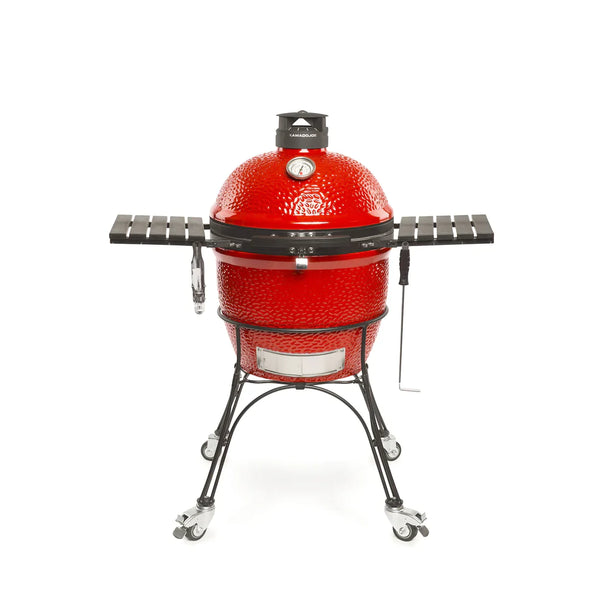
| Kamado Joe Classic Joe, Konnected Joe or another 46cm round kamado | Kamado Joe Classic pizza stone, 38cm | It sits above the heat deflector plates, so check you still have both. | $62.95Details → |
| Kamado Joe Big Joe or another 61cm round kamado | Kamado Joe Big Joe pizza stone | Sized for a 61cm grill and too wide for a 46cm kamado. | $59.95Details → |
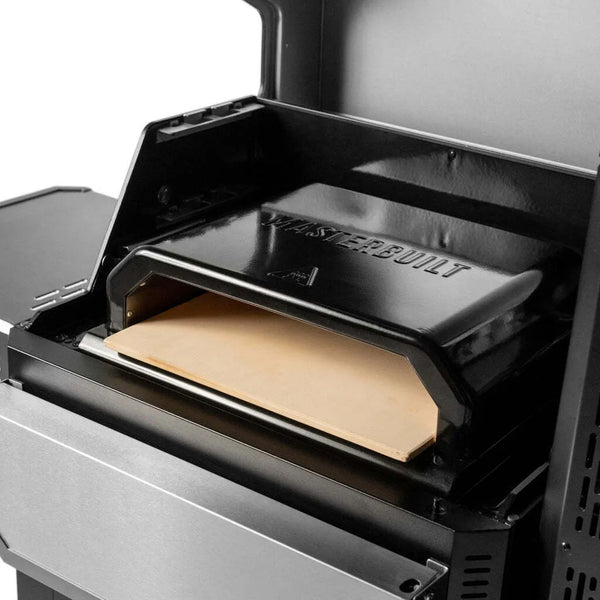
| Masterbuilt Gravity Series 800 or 1050 | Masterbuilt pizza oven attachment | Read the model number on the grill. It also fits the 600, 900, 1150 and XT, and does not fit the 560. | $289Details → |
Prices in this table are live from our catalogue, checked as the page loaded.Swipe the table →
Sit the stone in the middle of the grill with open bars showing all the way around it, so hot air can rise past the edge and brown the top of the pizza. The grill sizes in the first column leave at least 2.5cm on every side, about the margin Cadac leaves when it pairs its 25cm stone with a 30cm camp BBQ. A grill under 30cm is too small for any stone here. For a BBQ that size, look for a stone its own maker has sized to the model, as Weber does for its Q range with 26cm and 36cm stones.
What a pizza stone does on a BBQ
A pizza stone is a slab of fired ceramic that sits on the grill bars and stores heat. It goes on while the BBQ is cold and heats with it under the closed hood. By the time it is ready, the stone cooks the base by contact while the hot air trapped under the hood melts the cheese and browns the top.
A thin oven tray can't stand in for one. Light sheet metal holds very little heat, and cold dough cools it on contact, so the cheese is bubbling well before the underside has any colour. The 33cm stone is cordierite, a heat-tolerant ceramic, and its 1.68kg is all stored heat that keeps the surface hot when the dough lands.
Check a stone's maximum temperature before it goes into a hotter cooker. The 33cm stone is rated to 600C, so it has plenty in hand on a gas BBQ, where BeefEater has its owners preheat to 230 to 260C. Cadac's 25cm camping stone is cordierite too, but it is rated to 300C, so keep that one on gas. Kamado Joe's own pizza recipe runs a kamado at about 290 to 315C, and the heavy-duty ceramic stones it makes for its grills are the ones to use at that heat.
Pizza stone on a gas BBQ: bare stone or pizza box
Either one needs a gas BBQ with a hood. A bare 33cm stone relies on the hood to hold hot air over the pizza. The pizza oven box is a steel box with its own low roof, a removable square stone and a built-in thermometer, and it sits on the grill as one piece.
A grill under 50 x 45cm rules the box out. Where both fit, think about who is doing the topping. Kids building their own pile it on, and a thick layer of cheese and ham needs heat from above to finish before the base overcooks. The box is 14cm tall, so its roof sits close over the pizza. Thin bases with a light scatter of toppings do well on the bare stone, which stores on a shelf between pizza nights. The box is made for charcoal BBQs as well, provided the grill meets the same minimum size.

On a bare stone, every pizza night starts the same way:
- Stone on cold. Sit the dry stone on the grill before lighting anything. BeefEater's rule is never to put a cold stone into a hot BBQ, because it can crack.
- Every burner on high, hood down, 30 minutes. BeefEater tells owners of its hooded gas BBQs to allow at least that long to reach 230 to 260C. The supplier of the 33cm stone quotes about 15 minutes, which is the shortest preheat worth trying.
- Check the stone. Aim an infrared thermometer at the middle of the stone and wait for 230C. Without one, wait the full 30 minutes with the hood gauge at 230 to 260C. The gauge reads the air, and the stone heats more slowly.
- Bake a thin pizza on high. A thin, lightly topped pizza takes 5 to 7 minutes on high, the supplier's time for this stone, turned 180 degrees halfway. The box takes the same 5 to 7 minutes.
- Turn it down for a loaded pizza. If the base comes off dark with pale cheese, set the burners under the stone to low and the burner beside it to medium, let the hood gauge settle between 180 and 230C and bake for 10 to 12 minutes. Weber gives those settings for its own three-burner Genesis and Weber stone, after a 15-minute preheat with the lid closed.
Between them, BeefEater and Weber put gas BBQ pizza at 180 to 260C under the hood, and each wrote its figures for its own BBQs. Your BBQ's manual has the last word on burner settings. Weber's Q range, for one, bakes pizza on indirect heat with a convection tray and trivet under the stone, so a Q owner follows Weber's set-up.
Kamado Joe pizza stone set-up: deflectors first, stone on top
In a kamado the charcoal burns directly under the food, and a stone sitting straight over that fire scorches the base while the cheese is still cold. Two half-moon heat deflector plates go in between. They push the heat out to the walls and up into the dome, and the stone warms in moving hot air like the floor of an oven. The Classic Joe II ships with its deflectors, so the only part to add is the Kamado Joe Classic pizza stone. At 38cm it leaves about 4cm of open space all the way round on the 46cm cooking surface. A second-hand Joe, or one whose plates have cracked, needs a set of two half-moon deflector plates before any pizza goes in.

Light the fire about an hour before you want the first pizza, and build the kamado in this order:
- Fill the firebox with lump charcoal (a Classic Joe II takes up to 2.7kg), open the bottom vent fully and light it.
- Set both deflector plates on the accessory rack, the grates above them and the cold stone on the grates, so there is a gap of air between stone and deflectors and the stone heats with the kamado.
- Leave the dome open for about 10 minutes, then close it and open the top vent.
- Let the dome gauge climb towards 290 to 315C. About 30C short of your target, start closing the vents down, then make every later correction on the top vent. A vent change takes 10 to 15 minutes to show on the gauge.
- Burp the dome every time you open it once the kamado is hot. Lift the lid 5 to 8cm and hold it there for about 5 seconds to let the heat out before opening fully. This prevents a flashback.
Kamado Joe says pizza needs 260C or more, and its own recipe runs at about 290 to 315C and cooks a pizza in 7 to 9 minutes, well inside the Classic Joe II's 399C ceiling. The gauge reaches the target first, because the thick ceramic stone is the last thing in the kamado to heat through. The Classic Joe II manual allows 20 to 40 minutes for the kamado to settle at temperature before cooking, so give pizza the full 40 with the gauge steady. An infrared reading of 260C or more in the middle of the stone confirms it. The stone keeps gaining heat through the night and Kamado Joe notes the third pizza usually cooks faster than the first, so check the later ones early.
A Big Joe is set up the same way with the Big Joe pizza stone, and our Joe Jr vs Classic Joe vs Big Joe guide shows how the three sizes compare. Big Joe owners who bake pizza most weekends can step up to the Big DoJoe, an insert with its own stone that holds a steady temperature anywhere from 204 to 370C. On another brand of kamado, measure the grate and follow that maker's manual for its own deflector.
Masterbuilt Gravity Series: the pizza oven attachment
A Gravity Series has no bare-stone set-up. The Masterbuilt pizza oven attachment takes the place of the cooking grates and bakes a pizza up to 35cm across in 3 to 5 minutes with the lid closed, with no turning needed. It is a steel box with a stainless interior and its own stone, made for the 800 and 1050. Fit it while the grill is cold:
- Lift out the warming racks and the cooking grates.
- Sit the oven in the chamber with its stone inside.
- Hook a heat deflector into the openings on each side of the manifold and clip it in place.
- Cover the open space around the oven with the sizing panels that come in the box.
Fill the hopper, light it and set the controller to about 290C for a thick crust and up to about 370C for a thin one. Masterbuilt quotes 14 minutes for an 800 to reach 370C and 15 for a 1050, and the stone takes longer than the air around it, so launch once an infrared thermometer reads 290C on the stone. Build the pizza on a long-handled peel dusted with cornmeal. The hopper and fan are covered in how gravity-fed charcoal works.
The same oven sits on a gas BBQ with a cooking area 49.5 to 72.5cm wide and 42.5 to 51cm deep. Stand it on the grates with the panels covering as much of the cooking surface as they can, turn every burner to high and leave the lid open for about 15 minutes. Then bake with the lid closed on high for 3 to 5 minutes.
Preheating, launching and turning the pizza
The thermometer in the lid reads the air, and the stone takes longer to heat than that air does. An infrared thermometer reads the stone itself. The one we stock reads from -50C to 380C, which covers the top of Masterbuilt's range. Its distance-to-spot ratio is 12:1, so from 60cm away it measures a circle about 5cm across.
No maker prints a temperature for the stone itself. Each gives a cooking range for its own cooker, and the stone is ready once its surface has caught up to the bottom of that range:
| Cooker | Launch when the stone reads | The maker's range it comes from |
|---|---|---|
| Hooded gas BBQ | 230C | BeefEater, 230 to 260C for its gas BBQs |
| Charcoal kettle | 250C | Weber, 250 to 290C in its 57cm kettle recipe |
| Kamado | 260C | Kamado Joe, 260C or higher |
| Masterbuilt pizza oven | About 290C | Masterbuilt, about 290 to 370C |
Fifteen minutes is the shortest preheat any maker quotes. BeefEater asks for at least 30, and the longer soak heats the stone more evenly. Take the reading again after each pizza and wait for it to climb back before the next one goes on.
A long peel keeps your hands outside the hood. The 90cm pizza peel has an aluminium head measuring 31 x 36cm, and these steps are sized to it:
- Thaw a frozen base first. Cadac's stone manual warns that a frozen pizza on a preheated stone can crack it.
- Roll the base to 30cm. About 200g of dough makes one large thin base. At 30cm it sits inside the peel head and leaves 1.5cm of a 33cm stone showing on each side.
- Dust the peel generously. Kamado Joe's recipe uses semolina and Masterbuilt's manual uses cornmeal. Kamado Joe also allows a sheet of baking paper under the dough.
- Top it on the peel, inside 5 minutes. Weber's advice is to have the base on the peel no more than 5 minutes before it cooks, because after that the dough sticks.
- Shake the peel. A short shake should move the whole pizza. If an edge holds, lift it and throw more semolina underneath.
- Launch in one push. Rest the tip of the peel at the back of the stone, draw the peel out from under the pizza in one movement and shut the hood.
- Turn it halfway on a bare stone. BeefEater turns the pizza 180 degrees halfway through. Masterbuilt says its pizza oven needs no turning.

Pizza night for a crowd over the school holidays
Put the bases, a bowl of sauce and the toppings on a table a few steps back from the BBQ and let everyone build their own, kids and their mates included. One adult in heat-resistant gloves stays at the stone and does every launch and every turn. The Hardcore Carnivore high heat gloves are rated to 760C.
The dough is Weber Australia's recipe. One batch makes 4 large or 8 small thin bases:
- Stir 7g dried yeast and 1 teaspoon sugar into 325ml tepid water, about 40C, and leave it for about 5 minutes until frothy.
- Combine 400g pizza or Tipo 00 flour, 100g fine semolina and 1 teaspoon salt. Add the yeast mixture and 2 tablespoons olive oil and mix by hand until it comes together.
- Knead on a floured bench until smooth, then cover in an oiled bowl and rest somewhere warm for about 60 minutes, until doubled.
- Divide into 4 balls for large bases or 8 for small ones.
Scale the batches to the crowd: two batches for 8 large pizzas, three for 12. On a hot day the dough can double well inside the 60 minutes, so judge it by size. Balls for later rounds wait in the fridge and come out as the previous ones go on the stone.
The stone bakes one pizza at a time. Four large pizzas at 5 to 7 minutes each is 20 to 28 minutes of baking on a gas BBQ, 28 to 36 in a Kamado Joe at 7 to 9 minutes, and 12 to 20 in the Masterbuilt oven at 3 to 5, plus a few minutes between pizzas for the stone to climb back to its launch reading. Slice each pizza as it comes off and send it round the table, so nobody waits for their own.
In summer, keep cheese, meats and cut vegetables in the fridge at 5C or colder and bring them out in small bowls. Food between 5C and 60C is in the temperature danger zone. A bowl out for under 2 hours can go back in the fridge, between 2 and 4 hours it gets eaten straight away, and after 4 hours it goes in the bin. Cook raw chicken, mince and sausage to 75C in the centre before they go on a pizza, because the minutes on the stone are timed for the base. Leftover Christmas ham is already cooked and goes straight on. Leftover pizza goes into the fridge within the same 2 hours and gets reheated to 75C.
The stone stays hot long after the burners are off, so keep small hands at the topping table until the BBQ has cooled. For a burn, hold it under cool running water for at least 20 minutes, starting straight away, and skip the ice and creams.
Total Fire Ban days: pizza on gas, charcoal stays shut
Pizza night can still go ahead on a Total Fire Ban day if the stone is sitting on a gas BBQ. Anything that burns solid fuel stays shut until the ban lifts. The NSW Rural Fire Service rule names barbecues and wood-fired pizza ovens burning wood, charcoal or heat beads, and CFA Victoria adds spit roasts and smokers, so a kettle, a kamado and a Gravity Series are all caught. WA lists wood pellets by name, and it counts a patio or pergola open to the weather as outdoors.
A gas BBQ is allowed with conditions, and they differ from state to state. Each row is that authority's published rule for a gas BBQ, as read on 15 November 2026.
| State and authority | Clear space | Water or extinguisher | Supervision and location |
|---|---|---|---|
| NSW Rural Fire Service | 2m from anything combustible | Immediate and continuous water supply | Responsible adult present the whole time, within 20m of a permanent private dwelling |
| CFA Victoria | 3m from flammable material | 10 litres of water, or a hose connected to a tap | Adult present until it is completely out |
| Queensland Fire Department | No distance set | None listed | Queensland declares local fire bans by council area, and one can run for several days |
| South Australia CFS | 4m from flammable vegetation | Appropriate extinguisher at hand | Someone able to control it present until it is out, within 15m of a domestic or commercial premises |
| WA DFES | 5m from flammable material | None listed | Enclosed flame only, at your home or in an authorised area such as a public park |
| Tasmania Fire Service | 1m all the way around and above | None listed | LPG or electric only, with someone supervising the whole time |
| ACT Emergency Services Agency | Clear of materials that could burn | Fire extinguisher or continuous water supply | Constant adult supervision |
The Northern Territory writes its own rules too. Run a tape measure out from the BBQ to your state's distance and put the water in place before lighting, then cook with the usual gas method from the section above. The supervising adult has to stay at the BBQ from the moment a burner is lit, so somebody else carries the topped pizzas out. Bans are declared district by district, so read your state fire authority's page the night before and again on the morning of the cook. On ordinary days Kamado Joe recommends keeping a Classic Joe II 3m from walls and overhead construction.
Cleaning and looking after a pizza stone
Soap never goes on a pizza stone. The stone is porous, so detergent soaks in and comes back out in the next base. The clean-up is a burn-off while everyone is still eating and a dry scrape the next morning.
- Burn it off at the heat you baked at. When the last pizza comes off, shut the hood and give the stone about 15 minutes, which is Masterbuilt's instruction for its oven. Spilt cheese and sauce char to a crust that lifts off later. Skip this step for the 25cm Cadac stone, whose manual says to let it cool and then scrape.
- Leave it to cool in the BBQ. The stone stays hot long after the gauge drops, so leave it with the hood down, overnight if that is easier. Don't lift it out hot.
- Scrape and brush it dry. Once it is cold, run a metal dough scraper over anything raised, then sweep the crumbs off with a stiff, dry brush. The dark marks left by oil and sauce are stains, every stone gets them, and they can stay.
Water is where the makers disagree. BeefEater allows a warm-water rinse once the stone is cold, followed by a full air dry. Masterbuilt says never to get its stone wet, Cadac says to keep liquids and detergents off, and Kamado Joe says to brush its stone clean with no cleaning solutions. A dry scrape is allowed on every one of them, so make that your default and let your stone's own manual decide whether it can take a rinse. Napoleon sets 24 hours of drying for its stones after a rinse before they are heated again.
Sudden temperature change cracks a stone. Put it on the grill before lighting so the stone and the BBQ heat together, thaw a frozen pizza fully before it goes on, and keep water off a hot stone. The stone is also fragile, so carry it cold and with both hands. In the Masterbuilt oven, food with fat, oil or butter in it shouldn't touch the stone directly, so garlic bread goes on a tray. A new stone needs no oil or seasoning, and Kamado Joe covers its pizza stones and heat deflectors for 3 years.
Once the stone is clean and cold, take it inside and lay it flat in a dry cupboard. A stone left under the hood through a humid coastal summer sits in damp air for weeks. Burners and grates cop the same air, and our year-round grill maintenance guide for humid climates covers looking after those.
Our take
On a hooded gas BBQ, start with the 33cm stone, run every burner on high with the hood down and launch when the stone reads 230C. Move to the pizza oven box if the tops keep finishing behind the bases. Classic Joe owners want the Kamado Joe stone over the deflectors they already have, and Gravity Series owners want the attachment Masterbuilt sized to the grill. Add an infrared thermometer with any of them, because the stone's temperature is the number that decides when the pizza goes on, and keep the gas BBQ ready for fire ban days.
Frequently asked questions
Can you use a pizza stone on a gas BBQ?
Yes, as long as the BBQ has a hood to trap hot air over the pizza. Sit the dry stone on the open grill bars while the BBQ is cold, turn every burner to high, shut the hood and give it 30 minutes. BeefEater and Weber put gas BBQ pizza at 180 to 260C under the hood, each for its own BBQs.
What temperature should a pizza stone be on a BBQ?
It depends on the cooker. Launch at 230C on the stone for a hooded gas BBQ, 250C in a charcoal kettle, 260C in a kamado and about 290C in the Masterbuilt pizza oven. Each figure is the bottom of that maker's cooking range, read on the stone with an infrared thermometer.
How long do you preheat a pizza stone on a BBQ?
Fifteen minutes is the shortest any maker quotes, and BeefEater asks for at least 30 on its hooded gas BBQs. A kamado wants the full 40 minutes with the dome gauge steady at your target. The infrared reading on the stone is the real test.
Do you need a heat deflector under a pizza stone in a kamado?
Yes. Kamado Joe's set-up puts the heat deflector plates over the charcoal and the stone above them with a gap of air between. Without the deflectors the fire sits straight under the stone and burns the base.
Why did my pizza stone crack?
Sudden temperature change is the usual cause. The three common ones are a cold stone put into a hot BBQ, a frozen pizza on a preheated stone, and water on a hot stone. Put the stone in cold, thaw frozen bases fully and keep it dry until it has cooled.
Can I cook pizza on a charcoal BBQ or kamado on a Total Fire Ban day?
No. Solid fuel is banned outdoors for the whole day, which takes in a kettle, a kamado and a Gravity Series. A gas BBQ with a stone can still be used under your state's conditions on clearance, water and supervision, so check your state fire authority's page on the day.
Can you wash a pizza stone?
Never with soap, because the stone is porous and the taste comes back out in the next base. Scrape and brush it dry once it is cold. BeefEater allows a warm-water rinse for its stones, while Masterbuilt and Cadac say to keep theirs dry, so follow the manual for your stone.