Low first, hot last: the order is the whole trick
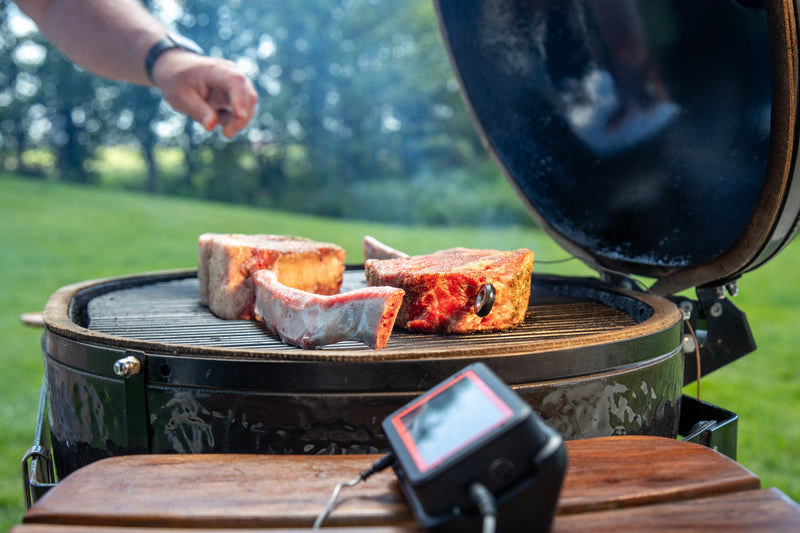
Reverse sear means cooking the steak gently until the middle is nearly done, then putting the crust on at the very end. On a kamado that's 110–135°C with the heat deflectors in until the centre reads about 46°C, a rest while you open the vents, then 60–90 seconds a side over 300°C or more. The result is medium-rare from edge to edge with a proper crust and almost no grey band.
It works on any grill with a lid. It suits a kamado better than most because of one habit of thick ceramic: it climbs fast and cools slowly. Going from low to searing takes ten or fifteen minutes. Coming back down from searing to low can take an hour. Reverse sear only ever asks the grill to go the easy direction.
Why a straight sear leaves a grey band
Drop a fridge-cold steak over a 350°C fire and the outside is doing all the work. Heat only travels into meat so fast, so while the centre crawls up from 4°C the outer centimetre races past well-done. By the time the middle reaches medium-rare you've got a brown crust, a thick grey ring under it, and a small pink core. The thicker the steak, the worse it gets.
Flip the order and the numbers change. In 120°C air the surface never gets far ahead of the centre, so the whole steak comes up together. There's a second benefit people miss: forty minutes in dry, moving heat dries the surface right out. A dry steak browns in seconds. A wet one has to boil off its moisture first, and that's time the heat spends tunnelling inwards.
Stage one: bring it up slowly

Set the grill up for indirect heat. The Series II Classic Joe and Big Joe both ship with the Divide & Conquer rack and a pair of half-moon heat deflectors; put both deflectors in the low position and the grate above them. (If yours have cracked or gone missing over the years, replacement plates for the Classic are a stock item.)
Light a small fire and start closing the vents down as the dome passes 90°C. The classic mistake is letting it run to 180°C and trying to drag it back. Ceramic doesn't give heat back in a hurry, so sneak up on your number.
- Steak: 4 cm or thicker. Rib-eye, scotch fillet on the bone, rump cap, a thick T-bone. Anything under 2.5 cm cooks through before the method can help; just sear those directly.
- Prep: salt it ahead if you can, pat it dry, and put a probe in from the side so the tip sits in the centre.
- Grill: 110–135°C at the grate, lid shut.
- Time: usually 30–50 minutes for a 4–5 cm steak. Cook to the probe, not the clock.
Pull it early. The sear and the rest will add the last few degrees.
| Doneness | Take it off the low stage at | Finished temperature |
|---|---|---|
| Rare | 43°C | 50–52°C |
| Medium-rare | 46–48°C | 54–57°C |
| Medium | 52–54°C | 60–63°C |
The changeover: ten minutes that do the resting for you
Steak off, onto a rack or board, uncovered. Now turn the grill around:
- Lift the grate and deflectors out with the grate gripper and heatproof gloves. They're well over 100°C. Park them on bricks or a paver, not the deck.
- Open the bottom vent and the top vent all the way.
- Drop the sear surface in as close to the coals as the rack allows and shut the lid.
A Classic or Big Joe will be past 300°C in ten to fifteen minutes; Kamado Joe rates both for searing between 260°C and 399°C. The steak rests the whole time, which is why it needs almost no rest after the sear.
One habit worth keeping: once a kamado is running hot with the vents open, burp the lid. Lift it a few centimetres, hold for a second or two, then open it fully. Throwing the lid straight up feeds a starved fire a gulp of air and it will flash back at your forearm.
Stage two: sixty to ninety seconds a side

You aren't cooking the steak any more. The inside is done; this stage is purely about the outside. Lay it on, leave it for 60–90 seconds, flip, repeat. Shut the lid between flips so dripping fat can't turn the firebox into a flare-up.
The standard stainless grate does the job. A cast iron sear plate does it better, because cast iron stores far more heat than wire and hands it over the moment the meat touches down. If you'd rather have an even, all-over crust than grill bars, the half-moon soapstone gives you a flat surface that also keeps fat off the coals.
Check with an instant-read as it comes off: 52–54°C for medium-rare, and it will coast up a couple of degrees on the board. Two or three minutes' rest is plenty.
The probe matters more than the grill

Reverse sear is a temperature method. Without a probe you're guessing at the one number that matters, and the dome gauge can't help: it reads the air at the top of the lid, not the middle of your steak.
Two tools cover it. For stage one, a leave-in probe so you can shut the lid and walk away. The FireBoard Pulse is wireless, reads the meat to within 0.2°C and tracks the grill temperature from the same probe. Take it out before the sear, though. Its ambient sensor is rated to 350°C and a full-vent kamado can go past that.
For stage two, an instant-read. The Hark Rapid is the sensible buy at ±1°C and USB rechargeable; the FireBoard Spark reads in about a second and logs to the same app as the Pulse. If you're choosing a leave-in probe specifically for kamado heat, we compared the two we'd trust in FireBoard Pulse vs The MeatStick.
Where it goes wrong
- Overshooting the low stage. If the dome's at 170°C you're roasting, not easing it up. Start closing vents early.
- Thin steaks. Under 2.5 cm there's no gradient to fix. Sear them hot and fast and move on.
- A wet surface. Don't wrap or cover the steak during the changeover. You spent forty minutes drying it.
- Pulling at the finished temperature. Take it off the low stage 8–10°C short. The sear supplies the rest.
- Leaving the deflectors in. A sear over deflectors is just a hot oven. The fire has to see the meat.
Frequently asked questions
How thick does a steak need to be for reverse sear?
About 4 cm or more. Between 2.5 and 4 cm it still works but the gain is small. Under 2.5 cm the steak cooks through too quickly for the low stage to do anything useful, so sear it directly instead.
What temperature do I take the steak off before searing?
For medium-rare, take it off the low stage at 46–48°C. The sear and a short rest carry it to 54–57°C. For rare pull at 43°C, and for medium pull at 52–54°C.
How long does a reverse sear take on a kamado?
About an hour for a 4–5 cm steak: 30–50 minutes at 110–135°C, ten to fifteen minutes to open the vents and bring the grill up to searing heat, and two to three minutes over the fire.
Can I reverse sear on a Joe Jr?
Yes. The Joe Jr has the same ceramic body and airflow control as the bigger grills, takes its own heat deflector, and the cast iron sear plate fits it as well as the Classic Joe. You'll fit two large steaks rather than four.
Do I need a cast iron sear plate?
No. The standard grate will sear a steak. Cast iron holds more heat and transfers it faster, so the crust forms sooner and more evenly, which means less time for heat to push into the middle.
Does reverse sear work for cuts other than beef steak?
It suits anything thick that you want evenly cooked with a crust: lamb racks, thick pork chops, tri-tip and rump cap. Use the finished temperature for that meat, and take it off the low stage 8–10°C short of it.