Cook lamb to 63°C for medium rare, 71°C for medium or 77°C for well done, measured in the centre of the thickest part. A leg, rack or rump keeps rising for a few minutes after it comes off the barbecue, so lift it about 3°C early. Rolled, stuffed and minced lamb are the exception: they need 75°C in the centre before they leave the heat.
| Doneness | Take off at | After resting |
|---|---|---|
| Medium rare | 60°C | 63°C |
| Medium | 68°C | 71°C |
| Well done | 74°C | 77°C |
| Rolled, stuffed or mince | 75°C | 75°C or more |
The finishing figures are from the NSW Food Authority, which asks for at least a 3-minute rest at 63°C. The 75°C rule is the Food Safety Information Council's. The rise on the bench, 3 to 6°C, is from Australian Lamb's doneness guide, the consumer site of Meat & Livestock Australia.
One set of numbers, so you do not have to pick. Some recipes, and Australian Lamb's own chart, put each name a few degrees lower (their medium starts at 65°C). We use the government figures all the way through this page. Ignore the name on the recipe and cook to the number in our chart for the look you want.
What each finish looks like when you slice it
| Finish and the cut face | Off at | Rested |
|---|---|---|
| Rare: deep red centre, very soft, thin brown edge | 57°C | 60°C |
| Medium rare: pink-red right through, juice runs pink | 60°C | 63°C |
| Medium: rosy pink centre, a wider brown band | 68°C | 71°C |
| Medium well: a faint blush in the middle only | 71°C | 74°C |
| Well done: grey-brown and firm all through | 74°C | 77°C |
| Slow-cooked shoulder to slice | 88 to 91°C | Rest 30 min |
| Slow-cooked shoulder to pull | 93 to 98°C | Rest 30 min |
Rare sits under the 63°C safety line, so keep it for whole pieces and skip it for anyone at higher risk, such as pregnant, elderly or unwell guests. Colour varies with the cut, the light and the lamb itself, so use the picture to know what you are aiming for and the probe to know when you are there. The shoulder readings follow Weber Australia's barbecue guide, and we let shoulder run to 98°C, when the probe slides in like butter.
Where to put the thermometer
Aim the tip at the centre of the thickest part, clear of bone, fat and gristle, as the NSW Food Authority advises.
- Bone-in leg: in from the side at the fattest point, stopping short of the bone.
- Rack: in from the end along the eye of meat, not down between the bones.
- Rolled leg or shoulder: straight into the middle of the roll from one end.
- Chops, cutlets, burgers and kebabs: in from the side or the end so the whole tip is buried.
On a big roast, check a second spot and trust the lower reading. The Hark Rapid instant-read covers -50 to 300°C to ±1°C, is IP65 rated and charges by USB, at around $40 to $60. The FireBoard Spark runs around $250 to $280: a Type-K thermocouple FireBoard rates at about a one-second read, ±0.4°C from -20 to 200°C, with a port for a leave-in probe.

For a leg or shoulder that takes an hour or more, a leave-in probe lets you keep the lid shut. The FireBoard Pulse has a meat sensor (-10 to 100°C, ±0.2°C) and an ambient sensor for the air at the grate (to 350°C), Bluetooth 5.3 and IP67, at around $230 to $270. The Hark Smart wireless thermometer has two probes, so a leg and a rack can be watched at once, at around $130 to $170. Set the alarm 2°C under your take-off number. More in our FireBoard Pulse vs MeatStick test.
Lamb cooking times by cut and weight
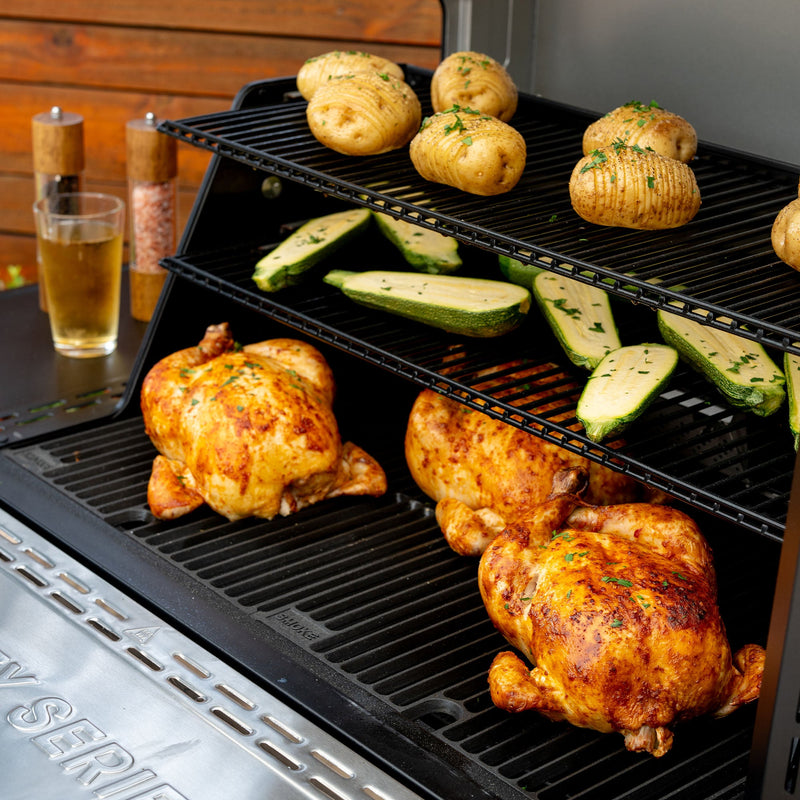
Indirect heat, lid down: on a gas barbecue, turn off the burners under the lamb; in a kettle or kamado, bank the coals or fit the deflector.
| Cut (BBQ temp) | Off at 60°C | Off at 68°C | Off at 74°C |
|---|---|---|---|
| Leg or shoulder, bone in (180°C) | 50 min/kg | 60 min/kg | 70 min/kg |
| Rump, round, topside (200°C) | 40 min/kg | 50 min/kg | 60 min/kg |
| Rack, any weight (200°C) | 20 to 25 min | 30 to 35 min | 40 to 45 min |
Those rows are Australian Lamb's barbecue roasting times, turned from per-500 g into per-kg figures. A rack takes about the same time whatever it weighs, because the eye is about as thick on a big rack as a small one. Weber Australia's lamb guide gives a 500 to 750 g rack 25 to 35 minutes for medium at 230 to 260°C.
- Boned and rolled leg, 1.25 to 1.5 kg: 1½ to 2 hours indirect at 190 to 230°C (Weber), and not done until the centre reads 75°C.
- Butterflied leg, 1.5 to 1.75 kg: 10 to 15 minutes searing over direct heat, then 20 to 30 minutes indirect (Weber). It is boned meat, so take the thickest lobe to 75°C.
- A 1 kg roast: about 50 minutes at 200°C for a boneless rump or topside to medium, or an hour at 180°C bone in. A 2 kg bone-in leg is about 2 hours, so start probing at 1 hour 40.
Chops, cutlets and kebabs
Direct heat, turned once. Small cuts barely climb after they come off, so lift them at the finish you want and rest them 3 minutes.
| Cut and size | Heat | Time for medium |
|---|---|---|
| Chop or cutlet, 2 cm | 210 to 240°C | 4 to 6 min |
| Chop or cutlet, 2.5 cm | 210 to 240°C | 6 to 8 min |
| Thick chop, 3 cm | 250 to 290°C | 8 to 10 min |
| Extra-thick chop, 4 cm | Sear, then indirect | 4 to 6 + 10 to 15 min |
| Mince burger, 2 cm | 210 to 240°C | 8 to 10 min, to 75°C |
Those are Weber Australia's medium times. Its lamb chart stops at 2.5 cm, so the 3 and 4 cm rows use its red meat steak times. For medium rare come off a minute earlier, and for well done add a couple. Untrimmed chops flare over open grates, so do them on the hotplate.
Lamb kebab times by cube size
| Cube | Rare | Med rare | Medium | Well |
|---|---|---|---|---|
| 2 cm | 3 to 4 min | 4 to 5 min | 5 to 6 min | 7 to 8 min |
| 3 cm | 4 to 5 min | 5 to 6 min | 6 to 7 min | 9 to 10 min |
| 4 cm | 6 to 7 min | 7 to 9 min | 9 to 11 min | 12 to 14 min |
This table is our own rough guide, not an Australian source: total minutes over high direct heat (230 to 260°C), turning every 1 to 2 minutes. Only the 3 cm medium figure matches a published one, Weber's 6 to 7 minutes. Treat every number as the time to start probing. Push the tip into one cube from the end and lift the skewers at 57, 60, 68 or 74°C for the finish you want. Koftas are mince, so they go to 75°C.
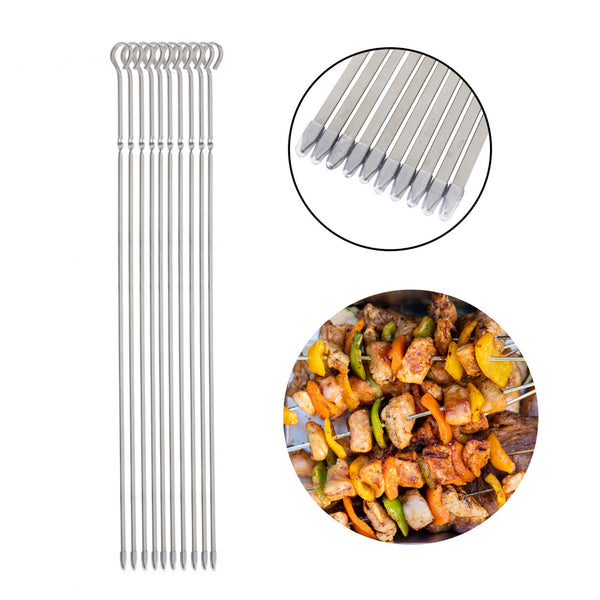
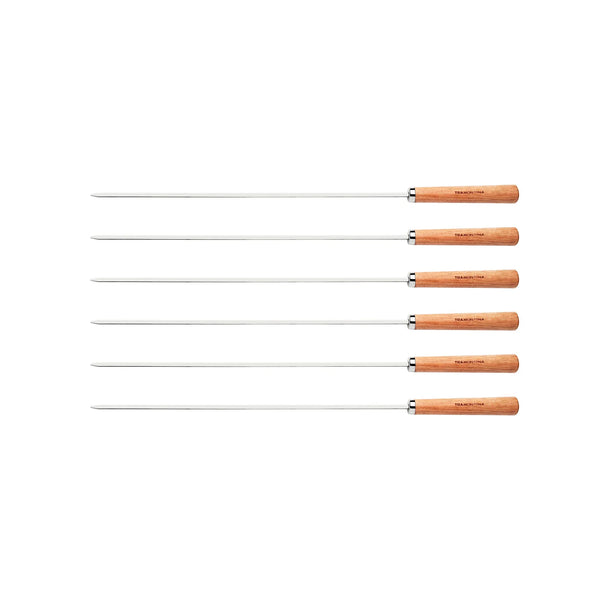
Cut the cubes to one size and leave a gap between them. Flat skewers stop the meat spinning. The Asmoke 43 cm skewers are flat 1.5 mm stainless steel, ten to a pack. For long skewers over charcoal, the Tramontina churrasco set has six 50 cm stainless skewers with FSC wood handles.
Resting lamb
Resting finishes the climb the chart relies on and settles the juices. Australian Lamb's rule is a minute per 100 g: about 10 minutes for a rack or 1 kg roast, 20 for a 2 kg leg, 3 for chops and kebabs, and 30 for a wrapped shoulder. Tent it loosely with foil so the crust stays crisp.
Slow-cooked and smoked lamb shoulder
Shoulder is full of collagen, which only softens after hours well past 70°C. At 71°C it is chewy. At 88 to 91°C it carves into soft slices, and at 93 to 98°C it falls apart. Weber gives a 1.25 to 1.5 kg rolled shoulder 6 to 7 hours at 100 to 130°C, and bone-in shoulders over 2 kg run longer.
- Run the cooker at 110 to 130°C with the lamb on the indirect side.
- Add two chunks of mild hardwood in the first two hours. Aussie Oak smoker chunks give a nutty smoke that does not swamp lamb.
- Expect a stall in the 70s. Wrapping in foil or butcher paper gets it moving again.
- Lift at 88 to 91°C to slice or 93 to 98°C to pull, rest it wrapped for 30 minutes, then shred it with Hark meat claws.
A kamado holds that heat for hours on one load of charcoal, and a pellet smoker holds it with no fire to tend. See the full smokers range and our smoking wood and fuel.
Rotisserie and spit lamb
The numbers stay the same on a spit: a whole leg comes off at 60, 68 or 74°C, and anything boned and tied goes to 75°C. Keep the heat to the sides over a drip tray, allow about the indirect times above, and stop the spit to probe away from the rod.
- The Grillz charcoal spit roaster has a 304 stainless rotisserie, a 240 V motor and three spit heights. Grillz rates it at up to 15 kg: a couple of legs or a shoulder, not a whole lamb.
- The JoeTisserie for the Classic Joe sits between the base and the dome and takes up to 5 kg. There is a Big Joe version too.
- The Masterbuilt Gravity Series rotisserie kit fits the 560, 800 and 1050 and is rated to about 9 kg.
See our spit rotisseries and the kamado spit chicken recipe for the method.
Buying, storing and carving lamb
Pick the cut for the cook you have time for:
- Under 15 minutes: cutlets, loin chops, backstrap and kebab cubes, straight over direct heat.
- Under an hour: a rack, rump or butterflied leg, seared and finished indirect.
- A couple of hours: a bone-in or rolled leg, roasted with the lid down.
- An afternoon: shoulder, smoked low and slow.
Buy chops of even thickness so they finish together. Get it home cold and keep it below 5°C, sealed on the bottom shelf of the fridge so nothing drips onto other food. The NSW Food Authority says to freeze raw meat you will not use within 2 days, and to thaw it in the fridge, never on the bench. For the freezer, the NSW Government's storage guide gives chops up to 4 months, steaks and similar cuts up to 6 and mince 2 to 3 months. Re-wrap it in meal-sized, dated packs.
Trimming and portioning is easier with a heavy blade. The Tramontina Nômade 10" butcher knife has a 25 cm hammered AISI 420 stainless blade and a full tang, for breaking down a shoulder or cutting a leg into steaks, at around $60 to $80. To carve, rest first and slice across the grain. Take a bone-in leg 1 cm thick down to the bone, then run the knife along the bone to free the slices. Cut a rack between the bones and a rolled leg into rounds. The Nômade 8" meat knife takes a full slice off a leg in one stroke, and the 6" boning knife follows the bone.
No thermometer?
Press the centre with the back of the tongs. Soft and yielding is underdone, a slow spring back is about medium rare, springy is medium and firm is well done. It is fine on chops with practice and useless for the 75°C cuts. A folding digital food thermometer costs under $30 and fits in the picnic bag.
Leftover lamb
The NSW Food Authority says to cover leftovers and get them into the fridge or freezer within 2 hours, eat them within 3 days or freeze them for up to 3 months. Carve the meat off the bone into shallow containers so it cools fast, and reheat it until it is steaming hot right through. We aim for 75°C in the centre.
For ham, turkey, pork and beef on the same table, see our meat temperature chart in Celsius. Every probe we stock is in BBQ thermometers.
Frequently asked questions
What temperature should lamb be cooked to?
63°C for medium rare, 71°C for medium and 77°C for well done in the centre, by the NSW Food Authority's figures. Lift whole cuts 3°C early, at 60, 68 or 74°C. Rolled, stuffed and minced lamb must hit 75°C on the heat.
Is it OK to eat lamb a little pink?
Yes, for a whole leg, rack, rump, chop or cutlet. The NSW Food Authority accepts 63°C with a 3-minute rest for whole cuts, and lamb at 63°C is still pink. Bacteria sit on the outside of an intact cut, which gets far hotter. Mince and rolled lamb need 75°C.
How long does a 1 kg lamb roast take on the barbecue?
About 50 minutes at 200°C for a boneless rump or topside to medium, or about an hour at 180°C bone in. Rolled roasts take about an hour and must reach 75°C. Rest it 10 minutes before carving.
How long do lamb kebabs take?
About 6 to 7 minutes for 3 cm cubes to medium over high direct heat, by Weber Australia's guide. Smaller cubes are quicker and bigger ones slower, so use our cube-size table as a starting point and lift them at your take-off temperature.
How long can raw and cooked lamb stay in the fridge?
Raw lamb: freeze it if you will not cook it within 2 days, by the NSW Food Authority's advice. Cooked lamb: up to 3 days, as long as it went into the fridge within 2 hours of cooking.
Should you sear lamb before roasting?
Not a leg: with the lid down it browns on its own. Sear a butterflied leg or thick chop, then finish it indirect. For thick cuts, the reverse sear gives a more even pink.
Do you roast lamb covered or uncovered?
Leave the lamb uncovered and close the barbecue lid, which works like an oven while the fat renders and the outside browns. Use foil only to tent it while it rests, or to wrap a shoulder through the stall.
What temperature for lamb mince, koftas and burgers?
75°C in the centre, by the Food Safety Information Council. Mincing spreads surface bacteria through the meat, so there is no pink option.