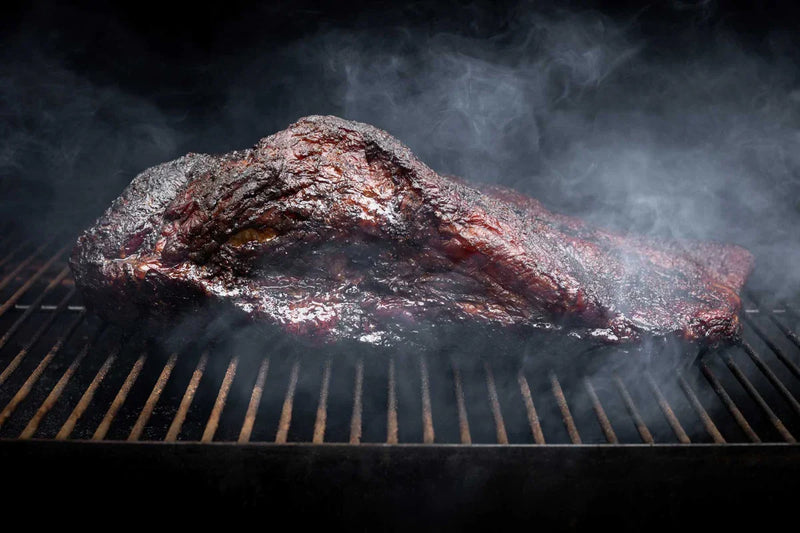
Roasting on a BBQ comes down to one idea: the meat sits beside the heat, not over it, and the hood stays shut so the cooker works like an oven. A hooded gas BBQ, a kamado, a pellet grill, a gravity-fed charcoal grill or a kettle will all roast a leg of lamb or a rolled pork loin at 160 to 200°C, and the same set-up bakes bread, pizza and a tray of brownies. Start with the times below, then set up your BBQ for indirect heat. If you want one roast to follow start to finish tonight, jump to our garlic and rosemary leg of lamb.
Roasting times and temperatures by cut
All times assume indirect heat with the hood down. Use them to plan when to light up, and use a thermometer to decide when the roast comes off: wind, cold and every lift of the hood stretch the clock on a BBQ.
| Roast | Hood temperature | Time to plan for | Take it off at |
|---|---|---|---|
| Beef rib roast, scotch fillet, sirloin, rump or eye fillet | 200°C | 30 to 40 min per kg (rare), 40 to 50 (medium), 50 to 60 (well done) | 60, 68 or 74°C |
| 2 kg standing beef rib roast | 200°C | About 80 min (rare), 100 min (medium), 120 min (well done) | 60, 68 or 74°C |
| Beef topside, silverside, blade or round | 160°C | 40 to 50 min per kg (rare), 50 to 60 (medium), 60 to 70 (well done) | 60, 68 or 74°C |
| Leg or shoulder of lamb, bone in | 180°C | 50, 60 or 70 min per kg (medium rare, medium, well done) | 60, 68 or 74°C |
| Rack of lamb | 200°C | 20 to 25 min in total (medium rare), 30 to 35 (medium) | 60 or 68°C |
| Pork scotch or leg, not rolled | 180°C | About 45 min per kg | 67°C |
| Rolled pork loin with crackling | 240°C, then 180°C | 40 min hot for the rind, then 30 to 35 min per kg | 75°C in the centre |
| Whole chicken, 2 to 2.5 kg | 190 to 230°C | 1¼ to 1½ hours | 75°C in thigh and breast |
| Turkey, 4 to 5 kg, unstuffed | 190 to 230°C | 1¾ to 2¼ hours | 75°C in thigh and breast |
| Bread, damper, cakes and tray bakes | 170 to 220°C | As the recipe says, checked 10 min early | A skewer comes out clean, or the loaf sounds hollow |
| Pizza on a stone | 250°C or more | Stone preheated 20 to 30 min, pizza a few minutes | Base crisp and spotted, cheese bubbling |
Where the figures come from: the beef times are Australian Beef's roasting chart, turned from per-500 g into per-kg, and the 2 kg row is its own barbecued standing rib roast, cooked at 200°C in a covered BBQ with the burners under the meat turned off. Lamb, pork and the birds are from Australian Lamb, Australian Pork and Weber Australia, as set out in our meat temperature chart and lamb cooking times. For a whole chook by weight, see roast chicken cooking times.
Safe internal temperatures and resting
The finishing temperatures come from the NSW Food Authority's cooking temperatures guide: 63°C for medium rare, 71°C for medium and 77°C for well done in beef, lamb, veal and pork, with at least 3 minutes of rest after 63°C, and 74°C for chicken and turkey. A whole roast keeps climbing 3 to 6°C on the board, so the take-off numbers in the table sit 3°C under the finish. Rolled, stuffed or boned-and-rolled roasts and birds get no head start: we cook those to 75°C in the centre while they are still on the heat.
Rest every roast loosely covered before you carve. Australian Lamb gives a minute for every 100 g, so about 20 minutes for a 2 kg leg, and 10 to 20 minutes suits most roasts. Probe the centre again at the end. If it is short, it goes back on with the hood down for a few minutes.
An instant-read thermometer such as the Hark Rapid (-50 to 300°C, ±1°C) answers in seconds. A leave-in wireless probe like the FireBoard Pulse shows the meat and the air beside it on your phone, so the hood stays shut. Both are in our BBQ thermometers range.
How to roast on a BBQ, step by step
- Set up for indirect heat. Fire at the sides, or under a ceramic or steel barrier, and nothing lit straight under the meat.
- Preheat with the hood down to 160 to 200°C: 10 to 15 minutes on gas, 20 to 40 minutes on a kamado or kettle.
- Load the roast on a rack in a tray over the unlit zone, with a cup or two of water or stock in the tray.
- Shut the hood and leave it. Steer with the burner knobs or the vents, one change at a time.
- Cook to temperature, not the clock. Probe the thickest part and take it off at the number in the table above.
- Rest it loosely covered for 10 to 20 minutes, then carve.
The sections below take each step in detail, cooker by cooker.
A roast to cook tonight: BBQ leg of lamb with garlic and rosemary
This is the roast we point people to when they first cook with the hood down: one bone-in leg, about 2 kg, indirect heat at 180°C, and potatoes cooking in the drippings underneath. It works on any of the BBQs below.
- Serves: 6 to 8
- Prep: 20 minutes, plus 30 minutes out of the fridge
- Cook: about 1 hour 40 minutes for medium rare, 2 hours for medium
- Rest: 20 minutes
- BBQ temperature: 180°C, indirect, hood down
- Take it off at: 60°C for medium rare, 68°C for medium
Ingredients
- 1 bone-in leg of lamb, about 2 kg
- 6 cloves garlic, cut into slivers
- 4 sprigs fresh rosemary, pulled into small tufts
- 2 tablespoons olive oil, plus a splash for the potatoes
- 2 teaspoons sea salt flakes, plus extra for the potatoes
- 1 teaspoon cracked black pepper
- 1 lemon
- 1 kg chat (baby) potatoes, halved
- 1 cup (250 ml) chicken stock
Method
- Get the lamb ready. Take it out of the fridge about 30 minutes before it goes on, pat it dry with paper towel and trim any fat thicker than about 5 mm.
- Stud and season. Push the tip of a small knife about 2 cm into the top of the leg in 12 to 15 places. Press a sliver of garlic and a tuft of rosemary into each cut. Finely grate the lemon zest over the meat, then rub on the oil, salt and pepper. Keep the zested lemon for later.
- Set up and preheat. Set your BBQ up for indirect heat and close the hood until the gauge sits at 180°C. On gas, run the outer burners and leave the middle ones off. On a kamado, fit both deflector plates. On a pellet or gravity-fed grill, simply set 180°C.
- Load the tray. Toss the potatoes in a splash of oil and salt in a heavy metal tray and pour in the stock. Sit a rack over the potatoes, put the lamb on the rack, and set the whole tray over the unlit part of the BBQ. The potatoes cook in the drippings.
- Roast with the hood down. Allow about 1 hour 40 minutes for medium rare or about 2 hours for medium, and start probing at 1 hour 20. On a two-burner BBQ, or if one side runs hot, turn the tray end for end halfway.
- Take it off by temperature. Probe from the side into the thickest part, stopping short of the bone. Lift it at 60°C for medium rare or 68°C for medium.
- Rest and crisp the potatoes. Move the lamb to a board, cover it loosely with foil and rest it for 20 minutes, when it will have climbed about 3°C. Meanwhile, turn the BBQ up to about 220°C and put the potatoes back for 15 minutes with the hood shut to crisp.
- Carve and serve. Squeeze the lemon over the lamb. Slice down to the bone about 1 cm thick, then run the knife along the bone to free the slices. Spoon the tray juices over the top.
The timing is Australian Lamb's barbecue roasting rate for a bone-in leg at 180°C, 50 minutes per kg for medium rare and 60 for medium, from our lamb cooking times guide, and the 20 minute rest is their minute per 100 g. A bigger or smaller leg just scales: a 2.5 kg leg wants about 2 hours 5 minutes for medium rare. What you need for it: a pair of folding stainless racks to lift the leg over the potatoes, an instant-read Hark Rapid or a leave-in FireBoard Pulse for the take-off reading, and on a Classic Joe the half-moon deflector plates.
Direct and indirect heat
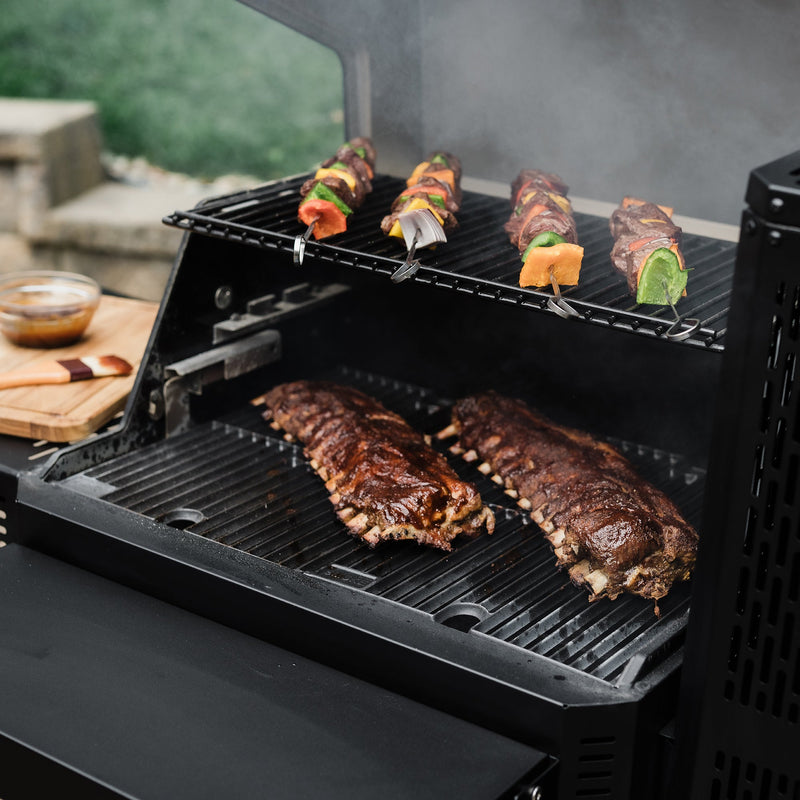
Direct heat, straight over a flame or coals, suits steaks, chops and snags that cook through before the outside burns. A 2 kg leg would be black outside long before the middle was done. Indirect heat puts the meat over the unlit part of the BBQ, and with the hood down hot air cooks it evenly from every side while the fat drips into a tray. Every set-up below is a different way of putting space, or a barrier, between fire and food.
How to set up each BBQ for roasting
Hooded gas BBQ with three or more burners
Light the outside burners, leave the middle ones off, and set the roast on a rack in a tray over the unlit burners with the hood shut. On a six-burner, run the outer pair each side. If one side runs hot, turn the roast end for end halfway. A BBQ with no lid cannot roast, so if you are shopping, look for a full-width hood and at least four main burners. The EuroGrille 5 burner has four 13 MJ/h main burners under a stainless hood plus a wok burner for the gravy, and the EuroGrille 9 burner adds a second hood and an infrared rotisserie burner for a crowd. See our free-standing gas BBQs and the wider gas BBQ range.
Steering a gas BBQ with the burner knobs
A gas BBQ has no thermostat. The knob sets how much gas flows, not a temperature, so the hood gauge is your feedback and the knobs are your only control. Use their whole range:
- Preheat on high, every burner, hood shut, until the gauge passes your target.
- Drop, then wait. Turn off the burners under the roast, bring the lit ones to medium and give the gauge 5 minutes.
- One knob at a time. Too hot, take one lit burner to low; too cool, raise one. Change everything at once and you cannot tell what worked.
- Use low. Two burners on low hold steadier, more even heat than one on high.
- Write it down. Note the knob positions that hold 180°C on a still day and start there next time.
Two-burner gas BBQ
Light one burner, put the roast over the other and turn the tray around every 20 to 30 minutes so the side facing the flame keeps changing. Smaller roasts suit it best: a 1.5 kg rolled loin, a chook or a rack of lamb rather than a 5 kg turkey.
Kamado
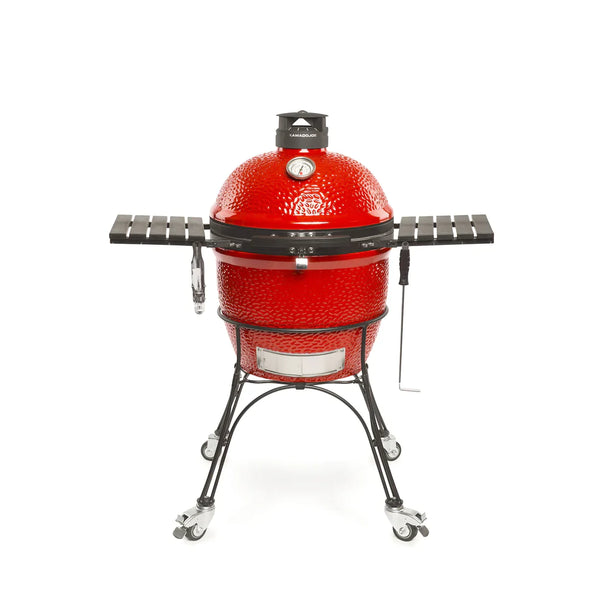
A kamado is the most oven-like BBQ you can roast on: thick ceramic walls hold a steady temperature for hours on a little charcoal, and roasts stay juicy. Ceramic deflector plates between fire and grate make it indirect. On the Kamado Joe Classic Joe II, the Divide and Conquer rack holds a pair of half-moon deflector plates made for the 18-inch Classic: one plate gives you a searing side and a roasting side, two give a full indirect cook. Steer it with the vents. Start closing them when the dome is 10 to 20°C short of target, and wait 10 to 15 minutes after each change. Browse our kamado BBQs.

Pellet and gravity-fed grills
These are the easy ones. A pellet grill burns under a steel baffle, so it is indirect by design, and a controller holds the number you set. A gravity-fed charcoal grill does the same with a hopper of charcoal and a fan. Set 160 to 190°C, put the roast on the grate, close the lid and leave it. There is no zone to build and no tray to turn. In a cold, windy winter, an insulating blanket helps a pellet grill hold its number. See our pellet grills, the Masterbuilt gravity-fed range and how gravity-fed charcoal works.
Kettle or other charcoal BBQ with a lid
Split the lit charcoal into two piles against opposite sides of the grate, or use charcoal baskets, and put a foil or metal tray between them to catch the drips. The roast goes on the cooking grate over that tray. Set the fire with the bottom vent, fine-tune with the lid vent, and keep the lid vent over the roast so heat is drawn across the meat. For a cook past an hour, add a handful of unlit briquettes to each pile every 45 to 60 minutes. See our charcoal BBQs.
Preheat with the hood down, then leave it shut
Give a gas BBQ 10 to 15 minutes with every burner on and the hood closed; a kamado or kettle needs 20 to 40 minutes to settle. Know which number you are chasing. For the roast itself, the gauge should settle at 160 to 200°C with the burners under the meat off. To sear a crust over direct heat before or after the roast, let it climb to roughly 250 to 300°C first, which usually takes a few extra minutes on high. Then:
- Treat the gauge as a guide. It reads the top of the dome, which can be 20°C or more off the grate. A probe with an ambient sensor near the roast tells you what the meat is feeling.
- Keep the lid shut. Every look costs heat, and gas can take 5 to 10 minutes to recover.
- Allow for wind and cold. Turn the BBQ so wind is not blowing into the burners, and allow extra time. Keep a spare gas bottle for a long roast.
Rack, tray and drip pan
Roast on a rack set in a heavy metal tray, or a disposable foil tray for a messy cook. The rack lets hot air reach the underside; a pair of folding stainless steel racks does it and folds flat afterwards. A cup or two of water, stock or wine in the tray stops the drippings burning and starts your gravy.
The liquid is also a chance to add flavour, because it steams gently up around the meat for the whole cook:
- Water or stock for a plain gravy base.
- Wine or beer: red wine under beef or lamb, a lager or pale ale under pork or a chook.
- Apple or pineapple juice under pork, cut with water so the sugar does not catch and burn.
- A splash of cider vinegar with water, which keeps pork drippings from tasting heavy.
- Leftover marinade. Anything that held raw meat is fine down there because it bubbles away for the whole roast, but boil the drippings hard for a couple of minutes before they go into a gravy.
Size the tray to the meat. It wants to be a little longer and wider than the roast, so every drip lands in it, but not so big that it sits over a lit burner, where the liquid boils off and the drippings scorch. Keep 1 to 2 cm of liquid in it and top up with hot liquid when it runs low. A plain metal baking tray or a disposable foil tray does the job; doubled foil trays are stiffer to lift when full.
Crackling, searing and smoke
Pork crackling on a BBQ
Crackling needs a dry rind and a stretch of high heat. Score the rind about 1 cm apart, pat it dry and leave the pork uncovered in the fridge overnight. Rub oil and sea salt into the score lines, give it about 40 minutes at 240°C with the hood shut until the rind blisters, then drop to 180°C to finish the meat. Our guide to pork crackling on a charcoal BBQ has the full timing and a fix for rind that will not crackle.
Sear first or sear last
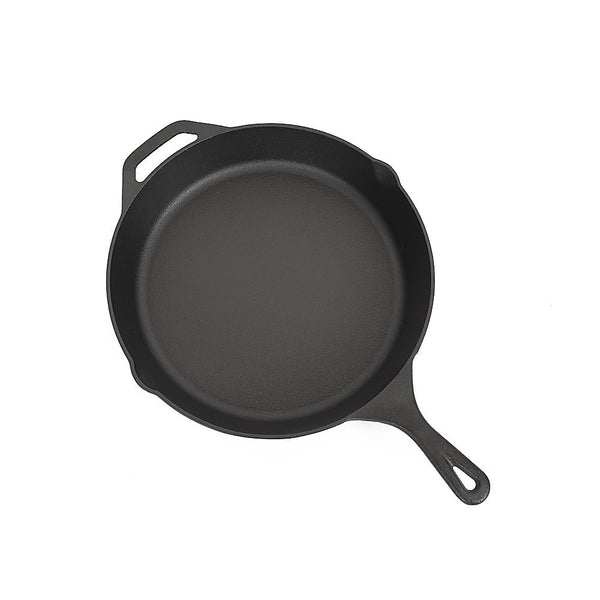
Beef and lamb taste better with a browned crust. Sear the roast over direct heat for a few minutes a side before it moves to the indirect zone, or reverse it: roast gently at 110 to 135°C until it is 5 to 8°C short of take-off, then sear it hard. The reverse sear gives a more even pink from edge to centre and suits a thick rib roast or rump cap. A 30 cm cast-iron skillet over the hottest part of the BBQ makes a good searing surface. More in our guide to reverse searing on a kamado.
Adding smoke: chunks, and wet or dry chips
A light smoke lifts a roast cooked at 160 to 200°C. Keep it to the first hour; after that it mostly turns the outside bitter.
- Charcoal and kamado: two or three wood chunks on the coals at the start. Chunks smoulder far longer than chips.
- Gas, short roast (a chook, a rack): dry chips. They catch fast and give a burst of smoke in the first 20 to 30 minutes, all a short cook takes up.
- Gas, long roast (a leg, a rib roast, a turkey): roughly half soaked, half dry. The dry chips smoke first and the wet ones only start once they dry out, so one load lasts longer. Wrap them in a foil parcel, poke holes in the top and sit it over a lit burner.
- Pellet: every pellet adds smoke. Nothing to do.
Match the wood to the meat. Apple chunks give a mild, easy smoke that suits pork and is a good first wood, cherry brings a sweeter smell and colour for poultry and pork, and dense ironbark has a bold flavour for beef. More on our hardwoods in stringybark vs ironbark, and the full range is under smoking wood and fuel.
Low and slow: smoke-roasting at 90 to 120°C
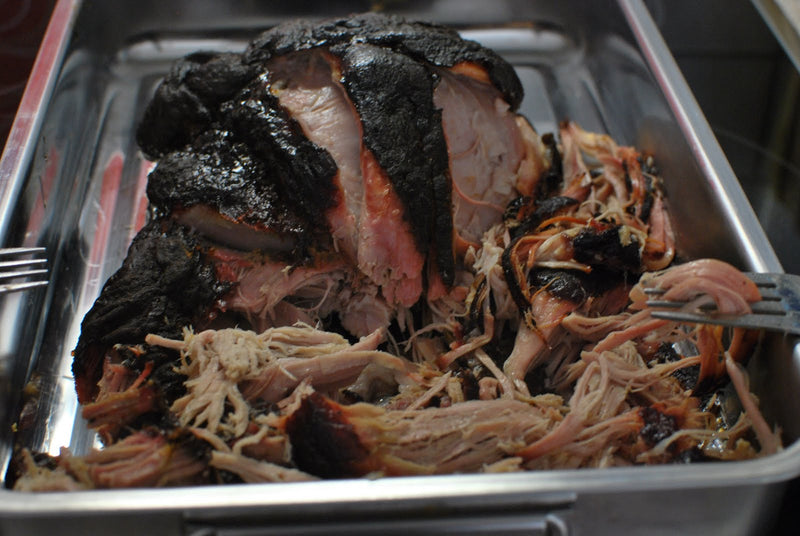
Tough, hard-working cuts such as pork shoulder, beef brisket, lamb shoulder and short ribs are full of connective tissue. At normal roasting heat it tightens and the meat eats chewy. Held at 90 to 120°C for many hours, that tissue slowly melts into gelatine, the meat stays moist and it pulls apart with a fork. Plan on most of a day: a 4 kg pork shoulder can take 10 hours or more. These cuts are safe well before they are tender, so keep going past the safe numbers until a probe slides in with almost no resistance, often somewhere in the low 90s °C inside.
Use a water pan. A tray of water in the cooker adds moisture to the air, slows the outside drying out and soaks up heat, which helps the cooker sit at a low, steady number. On a hooded gas BBQ, set a metal tray of hot water on the unlit side, under or right beside the meat; on a kettle, it goes between the two charcoal piles. Top it up with hot water so it never boils dry.
A purpose-built smoker makes this easier, because it is made to idle low for hours:
- The Masterbuilt WiFi 710 electric smoker sets from 38 to 135°C, has a removable water bowl and a side loader for wood chips, and you can watch it from the app.
- The Masterbuilt 40 inch digital charcoal smoker gives charcoal flavour with a digital controller, and comes with a water bowl and a split charcoal tray for low cooks.
- The Hark 2 Door gas smoker runs on an LPG bottle and has a separate lower door, so you can top up the chips and water without opening the main door and losing the heat.
- The Bradley 4 Rack digital smoker holds 40 to 135°C and feeds its own wood bisquettes, giving up to 9 hours of smoke without a refill.
Pellet and gravity-fed grills hold this band too. Compare them all in our smokers range.
Spit roasting and rotisserie cooking
A rotisserie turns the meat beside or above the heat, so it bastes itself and browns evenly.
- Truss tightly so nothing flops and catches as it turns. Use plain cotton kitchen string, the kind butchers tie roasts with, never nylon or plastic twine, which melts. Soak it in water for 10 minutes first so it scorches less. On a bird, tie the drumsticks together over the cavity and loop a second length around the body to hold the wings flat against the breast.
- Centre the weight. Run the spit through the middle and lock a fork at each end. Give each fork's thumbscrew a last half-turn with a pair of pliers: finger-tight screws work loose as the rod heats up and the meat's weight swings around. If the loaded spit always rolls to one side in your palms, reposition the meat or add a counterweight.
- Check clearance by turning it once by hand with the hood down before you light up. If the roast or bird hits the hood, it is too big for that BBQ: a hood propped open cannot hold roasting heat, so split the meat into two pieces on the spit, or move it to an open spit roaster built for the size.
- Heat to the sides or back, 150 to 190°C, with a drip tray under the full length of the meat. Any of the liquids in the tray section above work here too.
- Retighten the forks halfway, because meat shrinks as it cooks. Keep the pliers and your oven mitts beside the BBQ for it.
The JoeTisserie for the Classic Joe sits between the base and dome of a kamado and turns up to 5 kg, with a Big Joe version too. The Green Mountain Grills Ledge kit turns up to 11 kg, the Masterbuilt Gravity Series kit fits the 560, 800 and 1050, and the Grillz charcoal spit roaster has three spit heights for a party. Step by step: our kamado rotisserie chicken, and every model is under spit rotisseries.

No spit? Spatchcock the chook (backbone out, pressed flat) and it roasts faster and more evenly; start probing at 40 minutes. Or sit it on the Kamado Joe ceramic chicken stand, which holds about 470 ml of beer or stock and takes a bird of about 2.3 kg. It is done at 75°C in the thigh.
Baking on a BBQ: pizza, bread, damper and desserts
If a BBQ can roast, it can bake, with one extra problem: the base of a cake or loaf sits closest to the heat and burns before the top is done. Raise the tin on a rack or upturned tray, shield it with a pizza stone or steel (on a kamado, the deflector plates do this), bake over the unlit side and turn it halfway.
Pizza wants serious heat. Put the stone on while the BBQ is cold and preheat hard with the hood down. The cordierite Cadac pizza stone is rated to 300°C, which suits a hooded gas BBQ, the 33 cm BBQ pizza stone takes one pizza at a time, and kamado owners should use the Kamado Joe ceramic pizza stone. The Masterbuilt pizza oven attachment is an enclosed box with its own stone that bakes a pizza up to 14 inches (35 cm) in under 5 minutes. See our pizza stone guide and pizza ovens and accessories.
Bread and damper bake at 200 to 220°C indirect. A lidded cast-iron pot traps steam for a better crust; lid off for the last 15 to 20 minutes. Damper (self-raising flour, butter and milk) takes about 25 to 35 minutes at 200°C, until the base sounds hollow. A 35 cm cast-iron baking pan handles damper, focaccia and flatbreads.
Desserts such as brownies, crumbles and baked fruit work at 170 to 190°C indirect in metal tins, not glass. Check 10 minutes early, and keep a pair of five-finger oven mitts by the BBQ for hot tins and stones.
Our take
Any BBQ with a hood will roast. Four-burner gas is quickest on a weeknight, a kamado holds heat best and bakes best, and pellet or gravity-fed is set-and-forget for a crowd. Whatever you own, buy a good thermometer first: it is what makes the take-off column work. At Christmas, count back from carving through the rest, the cook and the preheat, and see our double smoked ham recipe for the ham.
Frequently asked questions
How do you cook a roast on a BBQ?
Set up for indirect heat (outside burners on and middle off on gas, deflector plates in a kamado, two charcoal piles in a kettle), preheat with the hood down to 160 to 200°C, and put the roast on a rack in a tray over the unlit area. Close the hood, cook until the centre reads your take-off temperature, then rest it.
Can you cook a roast in any hooded gas BBQ?
Yes, if the hood closes properly and there are at least two burners so one side can stay unlit. Three or four burners is easier. A BBQ with no hood cannot roast.
How long does a 2 kg roast beef take on a BBQ?
For a 2 kg standing rib roast at 200°C with the burners under it off, Australian Beef gives about 80 minutes for rare, 100 for medium and 120 for well done, then a 20 minute rest. Take it off by temperature: 60°C in the centre for medium rare, 68°C for medium.
How long does a leg of lamb take on a BBQ?
A 2 kg bone-in leg at 180°C with indirect heat takes about 1 hour 40 minutes for medium rare and 2 hours for medium. Take it off at 60°C or 68°C in the thickest part, then rest it for 20 minutes.
How hot should a BBQ be to roast meat?
160 to 200°C on the hood gauge for most roasts: the top end for poultry and small cuts, the lower end for big beef and lamb roasts. Crackling needs about 240°C to start.
What temperature should roast meat be inside?
The NSW Food Authority lists 63°C for medium rare, 71°C for medium and 77°C for well done in beef, lamb, veal and pork, and 74°C for chicken and turkey. Take whole roasts off about 3°C early. Cook rolled or stuffed roasts and birds to 75°C in the centre.
Can you slow-roast or smoke on a BBQ?
Yes. Hold 90 to 120°C with indirect heat and a tray of water in the cooker, add wood for smoke, and give tough cuts like pork shoulder or brisket many hours, until a probe slides in easily. A dedicated smoker or a pellet grill holds those low temperatures with the least fuss.
Can you bake on a BBQ?
Yes. Use indirect heat at 170 to 220°C with the hood down, and raise the tin or sit it on a pizza stone so the base does not burn. Bread, damper, pizza, cakes and crumbles all work.